
A tale of two candidates: ahead of tonight’s first Democrat debate in Las Vegas, we rank the Facebook performance of the major Democratic candidates for the presidential nomination.
Update, 6th November 2015: Ahead of the second Democrats’ debate in South Carolina today, we’ve gathered some up-to-date stats on how the candidates are faring on social. Since the below article was published, Lincoln Chafee and Jim Webb have both withdrawn from the race, leaving only three candidates in contention.
For the 30-day period from 6th October to 6th November, here’s how the candidates stacked up on social:
- Hillary Clinton is the most successful Democrat candidate on Facebook for this period, with a total of 3,585,030 engagements. She and Bernie Sanders remain closely linked however. Sanders pulled in 3,347,105 total engagements in the same time frame.
- 86% of Clinton’s engagements came from Facebook “likes”. Sanders continues to inspire significant sharing, with this metric accounting for 20% of his total interactions.
- Clinton continues to dominate her fellow candidates in Facebook comments. Some 235,718 comments were posted to her page across these 30 days. Her high-profile appearance at the House of Representatives’ Benghazi hearing on 22nd October is likely to have been an important factor in driving discussion.
- Clinton and Sanders’ biggest posts for this period were almost exclusively videos and images.
Original article:
Social media plays an ever-increasing role in political campaigning. We noted this last month on The Whip when we took a look at the performance of the leading Republican candidates for the presidential nomination on Facebook. That analysis revealed Dr. Ben Carson as a perhaps surprising leader on social, some margin ahead of the oft-discussed Donald Trump. This week, it’s the turn of the Democratic candidates, who will shortly take to the stage for their first party debate in Las Vegas.
For the purposes of the piece, we looked at the Facebook pages of Democrat candidates featured in major polls over a 30-day period from 6th September to 6th October. We measured Facebook likes, shares, and comments to get the total number of engagements for those 30 days. As always, the data comes from Spike. Here are the main takeaways:
- Bernie Sanders is the leading Democratic candidate on Facebook with 3,442,001 engagements.
- Hillary Clinton generated the most Facebook comments, notching up 174,436 in total.
- Bernie Sanders was the most widely-shared candidate, with his most popular post for the month earning over 189,000 shares.
- Candidates saw strong engagement on visuals-based posts and videos
The Democratic field differs substantially from that of the Republicans. There are dramatically fewer candidates – five in total at time of writing – and of those two have appeared as clear frontrunners both in the mainstream media and on social since the very beginning of the race.
[bctt tweet=”#feelthebern – Bernie Sanders the biggest Democratic candidate on Facebook in September”]
Sanders vs Clinton: Shares vs Comments
Fittingly, given the influential role social media has played in his campaign, Bernie Sanders is the top Democratic candidate on Facebook overall. In the 30-day period looked at for this post, he earned 3,442,001 engagements to gain a lead of almost 700,000 interactions over second-placed candidate Hillary Clinton.
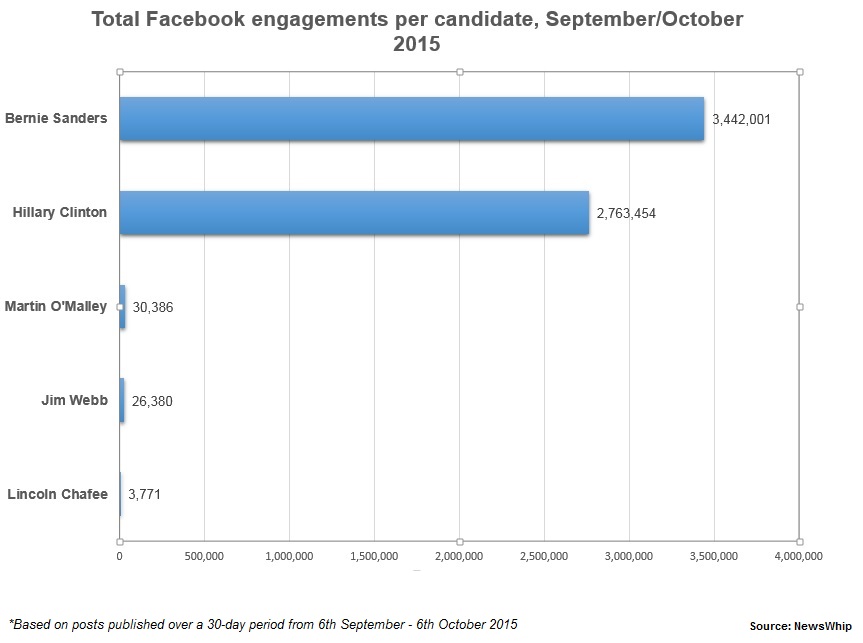
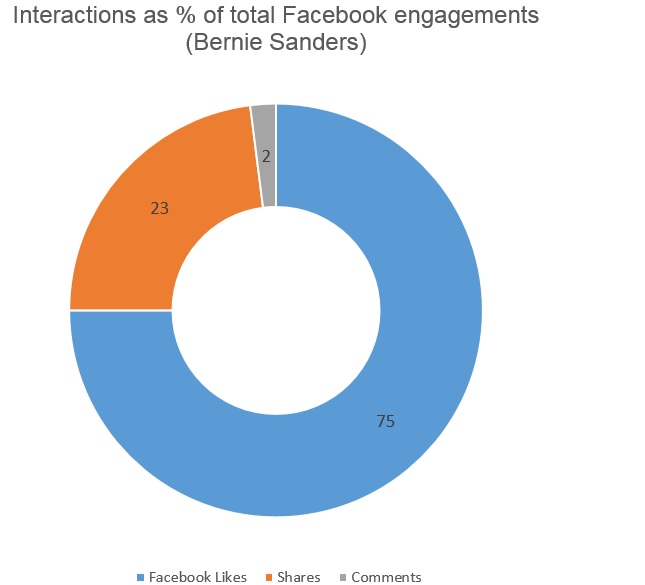
Clinton herself earned 2,763,454 total interactions in the same period. While this separates her from Sanders by some margin, her individual metrics suggest she has more prowess than it may seem. For one thing, she outranks Sanders for volume of comments on her page, and based on individual “likes” alone his lead thins considerably. In this 30-day period, Clinton harvested some 2,298,135 likes to Sanders’ 2,587,473. The main source of Sanders’ prominent lead is in the number of shares he’s earned over the course of the month. He has about 500,000 more shares than Clinton and this metric accounts for some 23% of his total score.
[bctt tweet=”Hillary Clinton leads Democrat candidates in comments to Facebook, with 174,436 in September/October”]
Martin O’Malley, Jim Webb, and Lincoln Chafee round out the list of nominees. Among these candidates, O’Malley and Webb are closely tied with 30,386 and 26,380 interactions respectively. Chafee however is some margin below them – according to our data he notched up a total of only 3,771 engagements across 30 days.
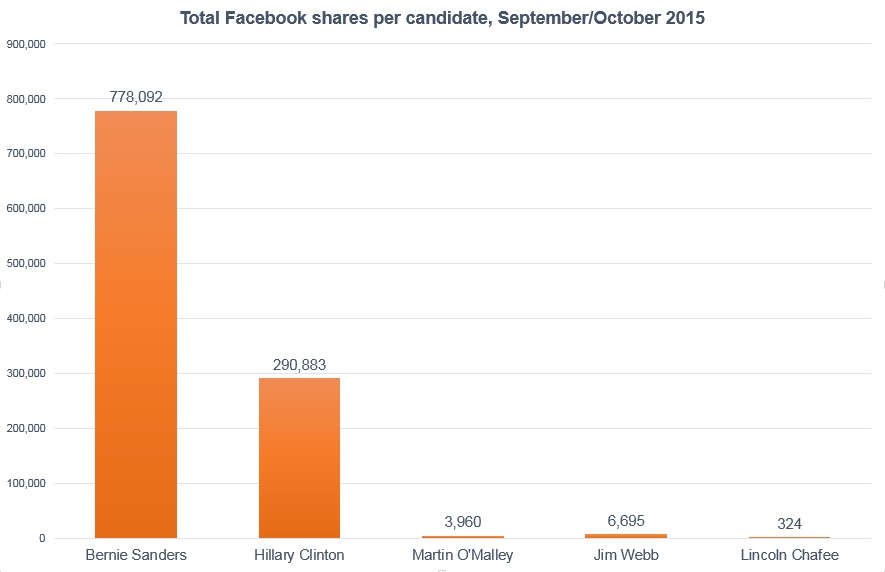
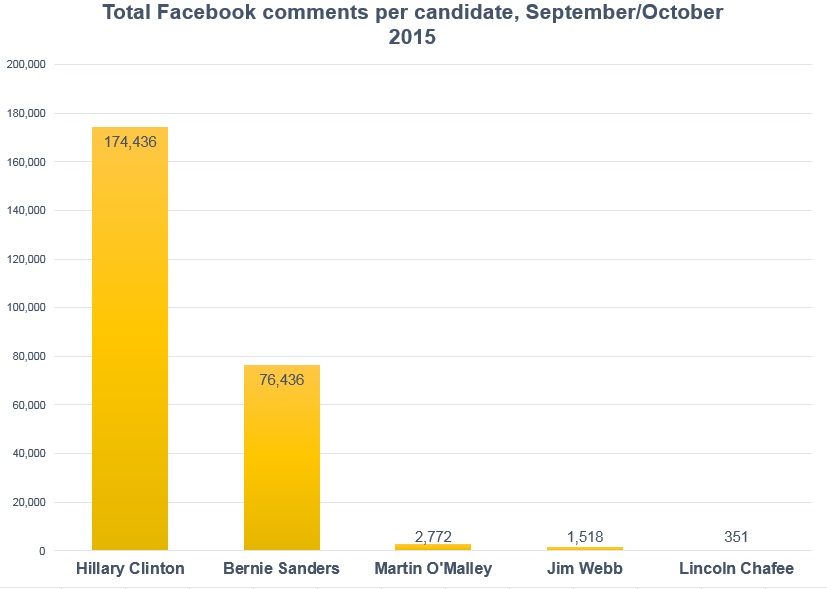 Breaking down the list by comments and shares, a number of interesting points emerge. Most notably – and similarly to the first and second-placed candidates in our ranking of the Republican nominees – Clinton, ranked second overall, moves into first when the list is ranked by volume of comments. She generated some 174,436 comments on her page over the 30 days looked at for this piece. To put that into perspective, Sanders generated 76,436, which is almost 100,000 fewer than Clinton. In other words, while Sanders may be driving the most overall engagement and certainly the most shares of any of the candidates, Clinton appears to be leading the way in terms of actual discussion on her page.
That said, it’s worth bearing in mind the continuing fallout from Clinton’s so-called “private email controversy”. This has been a bone of contention in the GOP debates and, to some extent, within the Democratic party itself. As a result, it’s possible that Clinton’s page has drawn more attention than it might have done in another month. The most-commented post on her page is a statement on the controversy, which has garnered 10,678 comments since going live on 9th September. For the month in total however, this post is only the fourth biggest on Clinton’s page. Instead, her most popular post was an excerpt from an appearance on The Tonight Show in a humorous segment poking fun at Donald Trump’s persona. This earned over 180,000 engagements, considerably more than her second and third biggest posts (both of which were images – one outlining her stance on taxation and one taken from Ellen Degeneres’ talk show).
[fb_pe url=”https://www.facebook.com/video.php?v=901074399947565″ bottom=”30″]
Interestingly, Sanders’ biggest post for the month was also a video. An eight-minute piece deconstructing income inequality notched up a staggering 261,445 interactions altogether, 72% of which were shares. This is notable as our previous analyses of video on Facebook would seem to suggest that predominantly shorter videos thrive on the platform. The huge figures attached to this post show that people are willing to consume longer pieces of content when it speaks directly to their interests. Further, visual media may be a more effective means of conveying campaign messages. Large chunks of text can be daunting in the news feed, but visuals allow complex information to be broken down into easily understandable points and shared onwards.
[bctt tweet=”Bernie Sanders’ Facebook video explaining income inequality was shared over 189,000 times in September”]
The high share count on this video is indicative of an overall trend on Sanders’ page. His top five posts for the month all yielded over 100,000 engagements and the top two over 250,000. Almost one-third of the numbers on Sanders’ top five posts came from shares. By contrast, only two of Clinton’s top five posts for the month earned over 100,000 engagements and only 16% of those numbers came from shares. Taking this into account along with Clinton’s greater tally of comments, it would appear that while Clinton is primarily driving debate on her own page, Sanders is extending his reach elsewhere across social. His following seems particularly intent on disseminating posts and messages, though evidently not so much that his own page loses momentum. This ripple effect is certainly in keeping with the general ethos of his campaign, which has attracted considerable coverage for its sterling use of social. Sanders’ popularity among younger voters and his atypical frankness as a candidate may also be endearing him to social-savvy voters.
Other Candidates
The remaining candidates for the Democratic ticket occupy something of a pool of one’s own. As noted above, third- and fourth-placed Martin O’Malley and Jim Webb are evenly tallied while fifth-placed Lincoln Chafee is some margin below them. Webb just edges out O’Malley when the candidates are ranked by shares, with 6,695 as against O’Malley’s 3,960. Both posted a fairly even number of updates over the 30-day period considered for this post – O’Malley posted 44 times to Webb’s 38 – so overall, they aren’t separated by much. However, barring a late-entry gambit by a high-profile name (such as Joe Biden), it seems highly unlikely that anyone will dislodge Clinton and Sanders from the top of the race on social.
Biggest Stories
Photos and other visuals appear to predominate on each of the candidates’ pages. As noted above, Sanders and Clinton’s top posts were videos, but posts with visual components performed well across the board. The candidates were also closely-linked in terms of the actual volume of updates across the 30-day period, with Sanders (129 updates) and Clinton (176 updates) posting in broadly similar numbers.
| Candidate | Post | FB engagements | |
| 1 | Bernie Sanders | Video: In-depth explanation of income inequality | 261,445 |
| 2 | Bernie Sanders | “That’s why we need a political revolution.” | 257,791 |
| 3 | Hillary Clinton | Video: The Tonight Show | 180,164 |
| 4 | Bernie Sanders | “This campaign will be driven by issues and serious debate” | 156,074 |
| 5 | Bernie Sanders | “When you tell a woman that she cannot control her own body, that’s extremism” | 131,908 |
In this ranking, as elsewhere, Sanders rules the roost. His video examining income inequality was the biggest of the month overall and something of a behemoth in its numbers. In addition to this, Sanders has three other posts in the top five for the month. True to his straight-talking persona, one of his biggest posts was an image quoting his aversion to personal attacks and negative ads, while a forthright response to September’s GOP debate also generated considerable numbers.
[fb_pe url=”https://www.facebook.com/berniesanders/photos/a.324119347643076.89553.124955570892789/898520063536332/?type=1″ bottom=”30″]
Clinton has benefited from high-profile appearances on talk shows with well-known figures Ellen Degeneres and Jimmy Fallon, with posts pertaining to these appearances figuring prominently in her most successful posts. As the fallout from the release of controversial videos about Planned Parenthood continues, she, like Sanders, posted updates reflecting her pro-choice stance.
[fb_pe url=”https://www.facebook.com/hillaryclinton/videos/982836661772863/” bottom=”30″]
By contrast with the field of Republican candidates, few of the Democratic candidates posted external links. Links to polls, donation forms, and newspaper articles were few and far between, suggesting that Democratic field appears to be more focused on crafting content specifically for their following on social. Text updates have tended to be short and snappy, while videos and images are carefully prepared and hosted natively.
Given that the Democratic race has been somewhat less heated than that of the Republicans, it will be interesting to see how these figures change over the course of the race. It seems likely that Bernie Sanders and Hillary Clinton will continue to dominate the rankings, though there is a possibility that the first party debate tonight will throw up some surprises. We’ll be returning to these rankings as election season progresses.
Now What?
1) Find the best stories on the social web, fast, with Spike.