
From @TheAthletic: Virat Kohli, the world’s most famous cricketer, has announced his retirement from Tests. The 36-year-old’s international future had been the subject of intense speculation in India. https://t.co/oENzt4cw86
— The New York Times (@nytimes) May 12, 2025
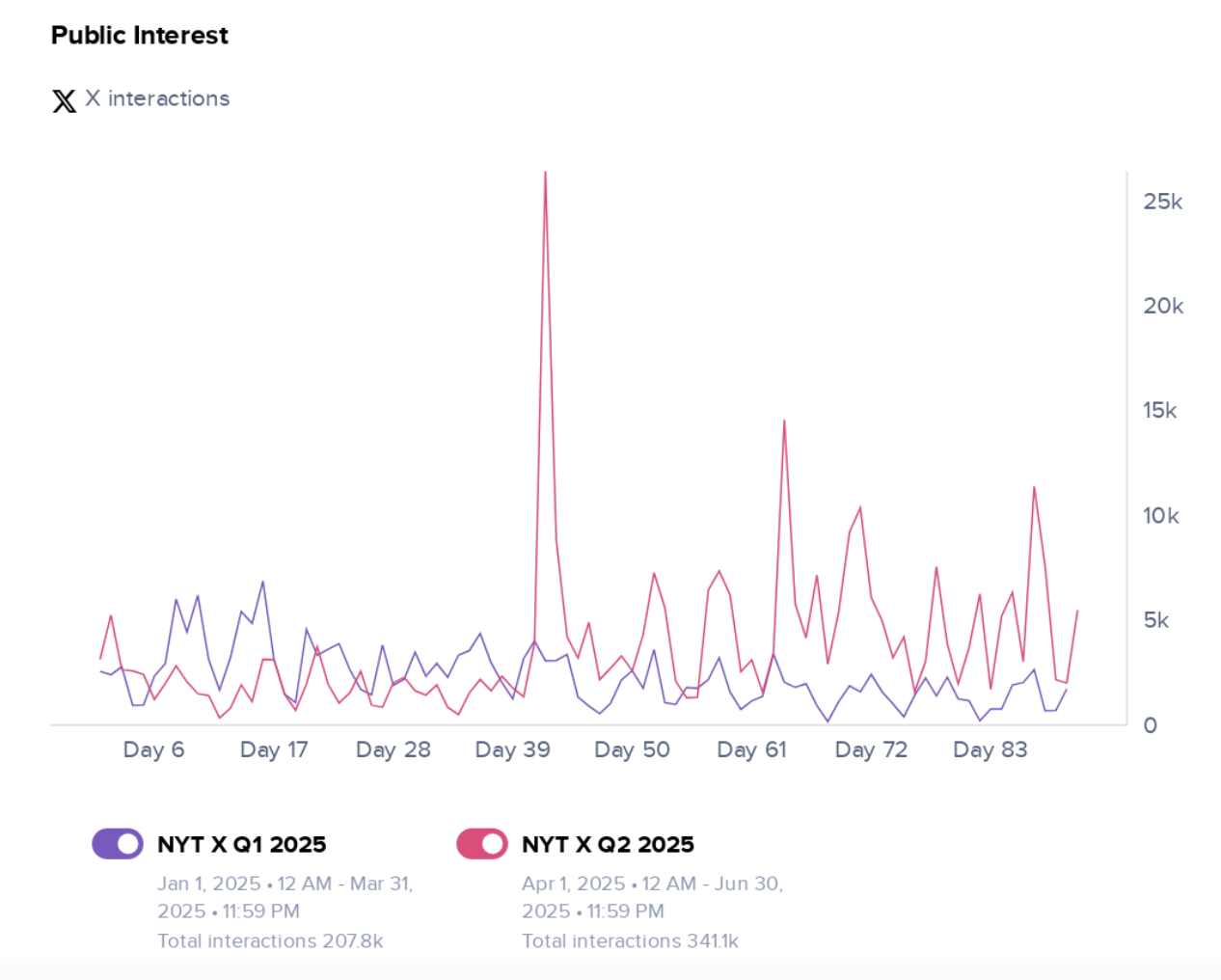
The highest-performing post for the publisher in Q2, a cross-posting from the Times’s sports brand The Athletic, drew over 22,000 interactions, compared to Q1’s top post which topped out at 1,465.
Formats: The Formula Stayed the Same
Despite the performance lift, the Times didn’t do much different when it came to its core format. In both quarters, the vast majority of posts were links to full articles. These accounted for 91% of the top posts in Q2 compared to 81% in Q1.
There was a modest increase in successful media use: image embeds grew from 2.8% to 4.3%, and native videos ticked up slightly. Conversely, plain-text posts in the top 1,000 dropped sharply, from 16% in Q1 to just 4% in Q2. Even so, these text-only updates did tend to overperform when deployed, particularly during early breaking coverage.
And speaking of breaking news, it was a key factor in the Times’s top posts. Nearly half of the top-performing X posts in Q2, 441 out of 1,000, included the phrase “Breaking News”, and those posts dramatically outperformed the rest. While they made up just 44% of the total, they drove 63% of all interactions, averaging 484 interactions per post. That’s more than double the 222 average for non-tagged posts.
The “Breaking News” label reliably lifted performance, especially on high-stakes stories like court rulings, violent incidents, and global conflict updates. Even though the quarter’s top post didn’t use the tag, the data shows it consistently correlated with successful posts and impact across the board.
Themes: Crime and World News Lead the Surge
In terms of content, Q1 was dominated by U.S. politics, with other themes contributing marginally. That changed in Q2. While politics remained the most frequent topic, posts about crime and justice and world affairs gained far more traction.
Crime and legal stories in Q2, including coverage of Supreme Court rulings, Donald Trump’s legal battles, and gun violence, totaled 105 posts and generated over 40,000 interactions, up from 43 posts in Q1. The average engagement for this category more than doubled, rising to 387 per post. These stories consistently topped the leaderboard, especially those related to trials or legal decisions with national implications.
World news also played a defining role. NYT posts covering the wars in Gaza and Ukraine, the Indian elections, and diplomatic tensions surged in engagement. Though only around 70 of these posts appeared in Q2’s top 1,000, they accounted for a disproportionate share of total interactions, with an average of over 900 interactions per post.
The Takeaway
The New York Times didn’t reinvent its X strategy in Q2. It refined it—leaning into a formula built around clean, link-driven headlines, timely global coverage, and courtroom drama. This ultimately led to a quarter where fewer posts delivered more impact, and the ceiling for engagement was raised dramatically.
For more on how publishers drove success, head over to our report.