Effective posting on Facebook can do wonders for your social engagement. We look at some simple tips to help improve your posts.
Every month, we see stories that have huge success on Facebook. While a good fan-base helps in spreading your stories on Facebook, presentation also goes a long way. With engagement with content on Facebook growing, it’s a good time for a primer in the simple science of good Facebook etiquette.
1. Put effort into pitching your story
When you see a link from a friend in your Facebook feed, you automatically look for context. Why should you click it? You check to see what your friend says about the video or link – is it controversial, hilarious, important or just interesting? The few words you type out to accompany the link might have everything to do with how its received by your friends.
It’s the same with publishers’ pages.
It’s hard to boil the all-important post pitch into any one set of commandments for social media managers. It will differ substantially according to the type of reader you’re hoping to reach.
The best advice is to know your audience.
For the BBC, that means an authoritative but approachable overview of the day’s news. For BuzzFeed, it might mean a self-explanatory image with a laconic caption.

Look at the few words of copy accompanying your link, video or image as a unique writing challenge. Think of the context of the piece and your audience. For news stories, look for a key quote, statistic or other hook with which to frame the piece.
Shorten untidy links and remove unnecessary ones.
If you’re going for humour, try it on some colleagues first. You mightn’t be as funny as you think you are.
Try to keep things as short and punchy as possible. Your description will be hidden behind a ‘Read more’ button if you go over a certain number of characters, plus your mobile readers will have to scroll like crazy just to get to the link.
And never, ever copy and paste the headline. That’s lazy, bot-like, and repetitive – it will also show up with the accompanying link.
2. Don’t be spammy, even accidentally
It sounds obvious, but spam-like behaviour is going to affect how Facebook’s algorithm ranks the reach of your post.
The network have said themselves that ‘like-bait’ and repeated content is going to be less and less visible in the future.
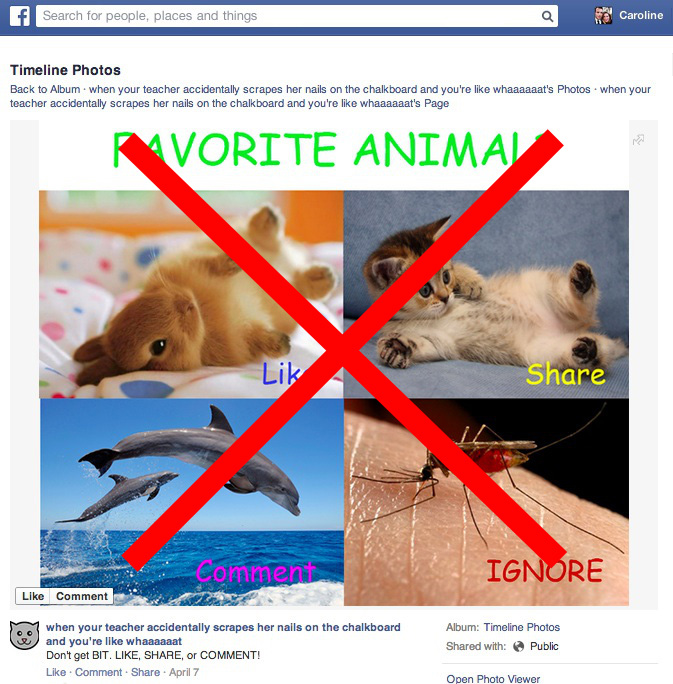
Asking people to ‘like’ or ‘share’ your image is an increasingly bad idea. Remember that readers can also report your posts if they find them annoying or spammy, ultimately reducing your timeline reach.
The growth in audience reach is not worth any negative association with your content. A human touch and clever writing is the way to go.
3. Make use of Facebook’s video autoplay
Facebook recently introduced the autoplay feature for videos on the timeline. Facebook reckon that the feature leads to up to 10% more engagement from users.
Video is close to the top of digital editors’ thoughts these days. By 2017, video will account for 69% of all consumer internet traffic, and it’s perfect for mobile devices. Investment in video publishing can yield significant rewards, as evidenced by some of the most successful Facebook video publishers of the past few months.
If you have good video content, give it plenty of exposure on Facebook. Remember that the majority of viewers will see at least the first few seconds, regardless of whether they pressed play or not.
4. Be careful about your posting schedule
Again, this seems obvious, but paying attention to your posting times can pay off.
There’s a lot of information out there on the best times to post, but this really depends on your audience. Keep an eye on your page insights tab to see what time-zones you’re likely to hit most frequently.
Regular posting is a good idea. It negates the time decay factor, which is something taken into account when it comes to timeline visibility.
However, it’s not just a question of when – it’s also a question of what, when. Which brings us to our next point…
5. Be aware of what’s going on with your audience
It’s important for publishers to understand that they shouldn’t simply treat Facebook as a dumping ground for everything that goes on their site if they want to see significant social engagement.
Your fans will quickly tire of a constant stream of stories with little relevance or interest to their life. Bigger publishers like the Guardian and the New York Times are able to choose the best-performing stories from their site, and pitch them with an air of intrigue.
For smaller newsrooms and brands, the ever-gaping maw of content creation poses a tougher problem. You can’t afford to not hope for every story to go down well on Facebook.
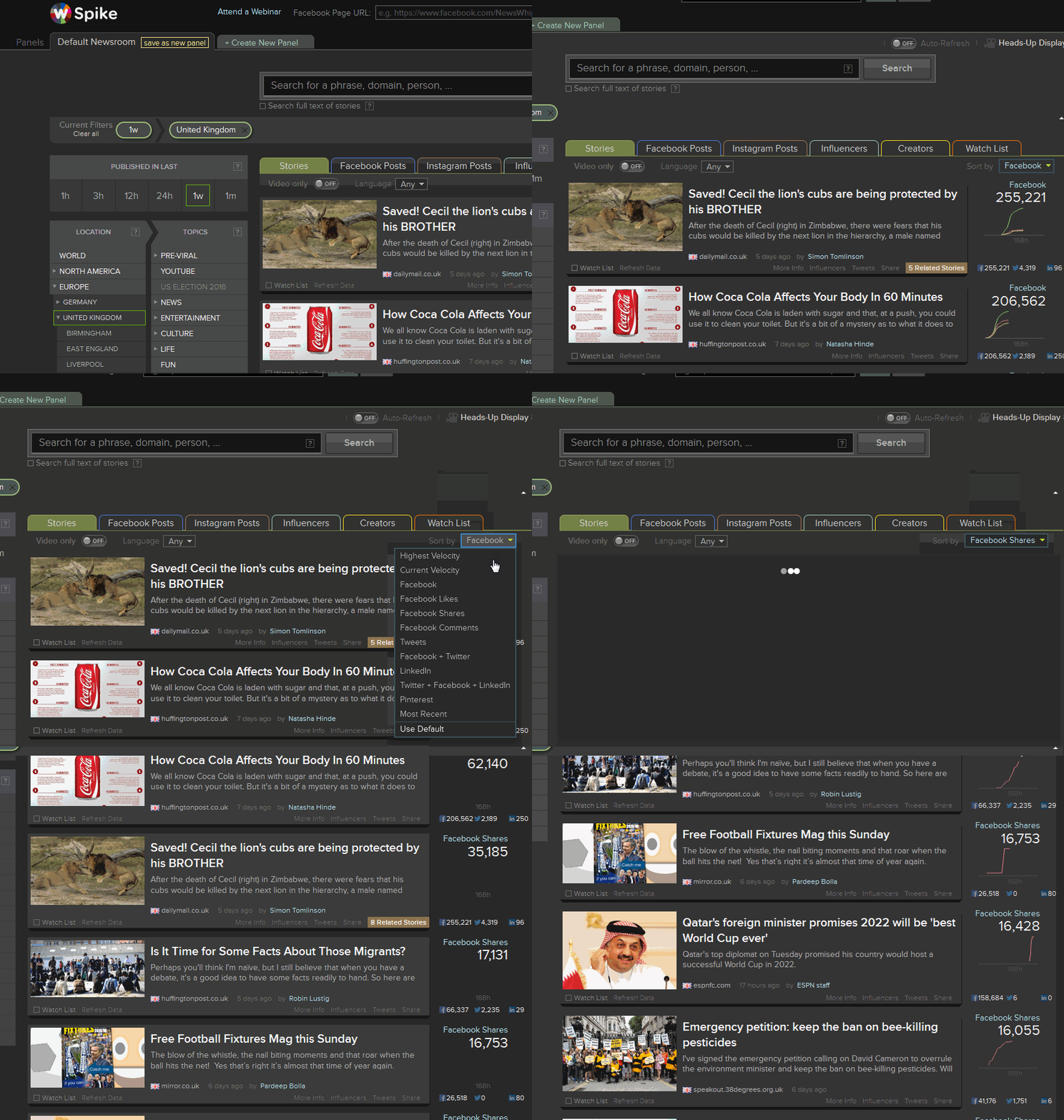
That’s part of the reason we built Spike – it gives an objective, realtime view of what’s blowing up on Facebook and Twitter in different categories and countries. It helps newsrooms find out whether what they’re writing about is interesting people, show them what’s relevant to their audience right now, and what to focus on next.
6. Encourage and engage with comments and feedback
Comments are an important factor in determining your post’s value to the Facebook timeline – if people are interacting and expressing interest in what you’ve posted, Facebook will want to make others aware of that.
Research by Kissmetrics indicates that posts posing questions may receive up to 100% more comments than those that don’t. This article also takes a look at the type of posts which tend to attract more comments.
Don’t be too aloof – if there’s a question you can answer knowledgeably in the comments, or if there’s any additional info you can add, go ahead.
Please let us know what we left out of this list on Twitter.
Next:
1) Follow us on Twitter for daily updates from our blog, and more
2) Take a Spike trial to keep on top of what your audience is talking about on Facebook.