Did you read the story suggesting there’s no correlation between shares and content being read? It turns out there’s more to it.
Last week, I became the last person on the Internet read a story by Adrianne Jeffries of The Verge called “You’re not going to read this…But you’ll probably share it anyway”.

If you’re into all things online publishing, it’s a shocker. The article quotes Tony Haile of online analytics company Chartbeat who tweeted “we’ve found effectively no correlation between social shares and people actually reading.”
Why is this a big deal? As Jeffries wrote:
The media industry has fully digested the idea that likes and retweets are marks of merit and that the viral effect of social media is the ultimate affirmation of relevance, which is why every major news organization now has at least one social media editor. To suddenly say that a story is just as likely to have been read by a million people and tweeted by none of them, as it is to have been tweeted a million times and yet never read, seems impossible. And yet, that’s what Chartbeat has found.
The story echoed around the news-about-news web: “News flash: People rarely read before tweeting stories” wrote Daniel Derdiman of CNET. “Chartbeat said it has done research that demonstrated that there is no correlation between people actually reading articles and tweeting about them.” Another industry blog covered the piece, saying “most of the links that we read on Twitter have never been read by those who posted them.”
The story’s claim – which is wonderfully counterintuitive and dramatic – brought huge social engagement with 3,600+ tweets, 1,900+ Facebook shares, 600+ LinkedIn shares, and 1000+ Google Plus shares.
Of course, if it’s true, those social stats are absolutely zero indicator that anyone actually read it.
What Chartbeat actually found
When I read the Verge story I was surprised. NewsWhip has long used social activity as an effective way of signalling engaging content. Plus I could not find data published by Chartbeat to support the idea that “a story is just as likely to have been read by a million people and tweeted by none of them, as it is to have been tweeted a million times and yet never read.” That would suggest zero relationship between the content people engage with the the content they share.
Surely more social traffic means more reads? And surely people tweet engaging content? I contacted Josh Shwartz, Chartbeat’s Data Scientist, to fill me in.
While Josh no longer has the original data that prompted the article, he was able to tell me what the analysis suggested. It turns out the findings are not so dramatic as I understood them to be.
[Our finding] doesn’t mean, of course, that social activity doesn’t drive traffic (it obviously does) or that individuals who take social actions aren’t more engaged on page (we don’t collect the Twitter account of each individual reading a page, so we don’t have any data about this). It does mean that stories that are highly social are not more likely to be deeply read by the average reader, and stories that are deeply read are not more likely to be socially active.
So a social story might get more views, but those individual views on average won’t be any deeper than reads on a less social story.
Stories can be long or short
At least for me this is not such a disruptive finding – certainly not as disruptive as “few people read the content they share.” The length of time of an individual engagement with a story comes from that story’s length and stickiness, not from the number of tweets and shares.
Say “Acme Cement Announces Third Quarter Profits” gets 200 reads, with none of those coming from social. The total engaged time by all readers is 400 minutes, giving an average engaged time of 2 minutes per reader for 200 readers. Not a social story.
Meanwhile, “Bieber Nipple Slip” (sorry) gets 20,000 reads, with 15,000 of those coming from social. The total engaged time is 40,000 minutes. Once again, the average engaged time (again) of two minutes per reader, though this time for 20,000 readers. A very social story.

One of those stories clearly got more engagement, by volume. But both had the same average read time. As far as I understand it, Chartbeat’s data deals only with the reading time – two minutes for each. The statement that there’s “no correlation between shares and reading” refers only to the average length of time a reader spends with each story.
Some stories – especially some viral stories – are short. (One of the most shared stories for The Verge in December was the brief ‘House of Cards Season two premieres February 14 2014’). A relationship between engagement time and level of sharing would only result if readers spent more time on the more shared stories. Chartbeat suggests that is not the case, though data from individual users focused on time of tweeting and levels of engagement would be needed to test it.
So are people really reading stories they tweet?
A controversial suggestion from the Verge article was that there’s no correlation between what readers read and what they share. While that’s not suggested by the data, that’s the angle picked up readers by others who blogged about the story (including CNET).
However, Chartbeat does not gather information on when a given reader tweets a story, or when they do so, or whether the people tweeting a story are the ones reading it. So those conclusions seem to be totally unwarranted. They’re fun to make – who doesn’t love the idea that everyone is mindlessly tweeting. It sometimes seems that’s what “everyone else” is doing.
But – as The Verge story noted – Upworthy’s Daniel Mintz found people who engaged with a story longer were in fact more likely to share it.
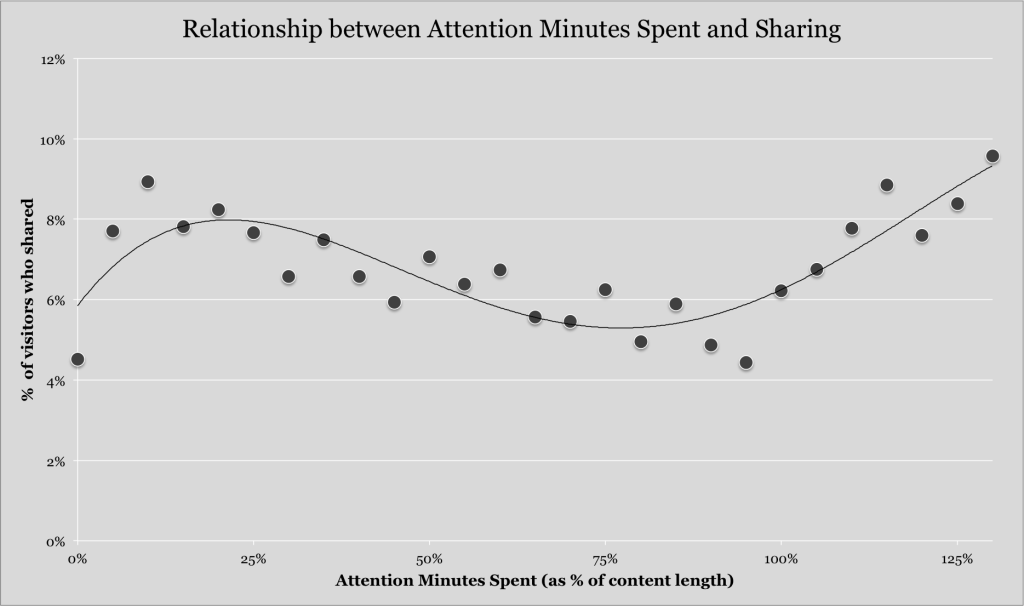
So yes, writers, your hard written stories are being shared (at least mostly) by people who actually read them.
Social distribution is not going away
If any publishers decided social was meaningless and slowed building their social network distribution capacity as a result of The Verge’s story, they should speed back up. “If it doesn’t spread, it’s dead,” as MIT Professor Henry Jenkins says. And social signals remain an incredible way of assessing what the world cares about any given minute.
A share is still a real signal of value by a real person, somewhere. Put together a billion of them and you have quite the map of what matters.
Special thanks to Josh Schwartz of Chartbeat for taking some time out from his busy schedule to clarify their findings for me.
To see the map of what matters, check out Spike. (Obligatory plug, but we promise you won’t regret clicking.)