
Who are the biggest publishers of political posts on the web and Facebook in 2018 so far? We looked at the data to find out.
Politics has become increasingly ubiquitous in how we talk to each other, especially on social media.
Last year, we did a report focused on the rise of hyper-partisan publishers, and this report will be a continuation of that theme.
From the mainstream of CNN and Fox News, to the political points of view of the Daily Wire and Mother Jones, to the outright conspiracy theories that abound on some websites, there is plenty to talk about when it comes to politics and the news, perhaps now more so than ever.
In this updated report we looked at:
- The most successful mainstream publishers writing about politics
- Outlets that approach politics writing from a left/right angle
- Known sources of fake/biased news and who is driving engagements on these articles
But right now, we’re only going to talk about one of those factors. One of the things that we noticed amongst all of this was the continued engagement to InfoWars’ web content, despite its being banned from nearly every major social platform.
InfoWars
InfoWars is, according to numerous third-party sources, one of the foremost purveyors of conspiracy theories and inaccurate news currently active. InfoWars’ banning from Facebook and other platforms caused a big stir at the beginning of August, with accusations of censorship flying in many directions.
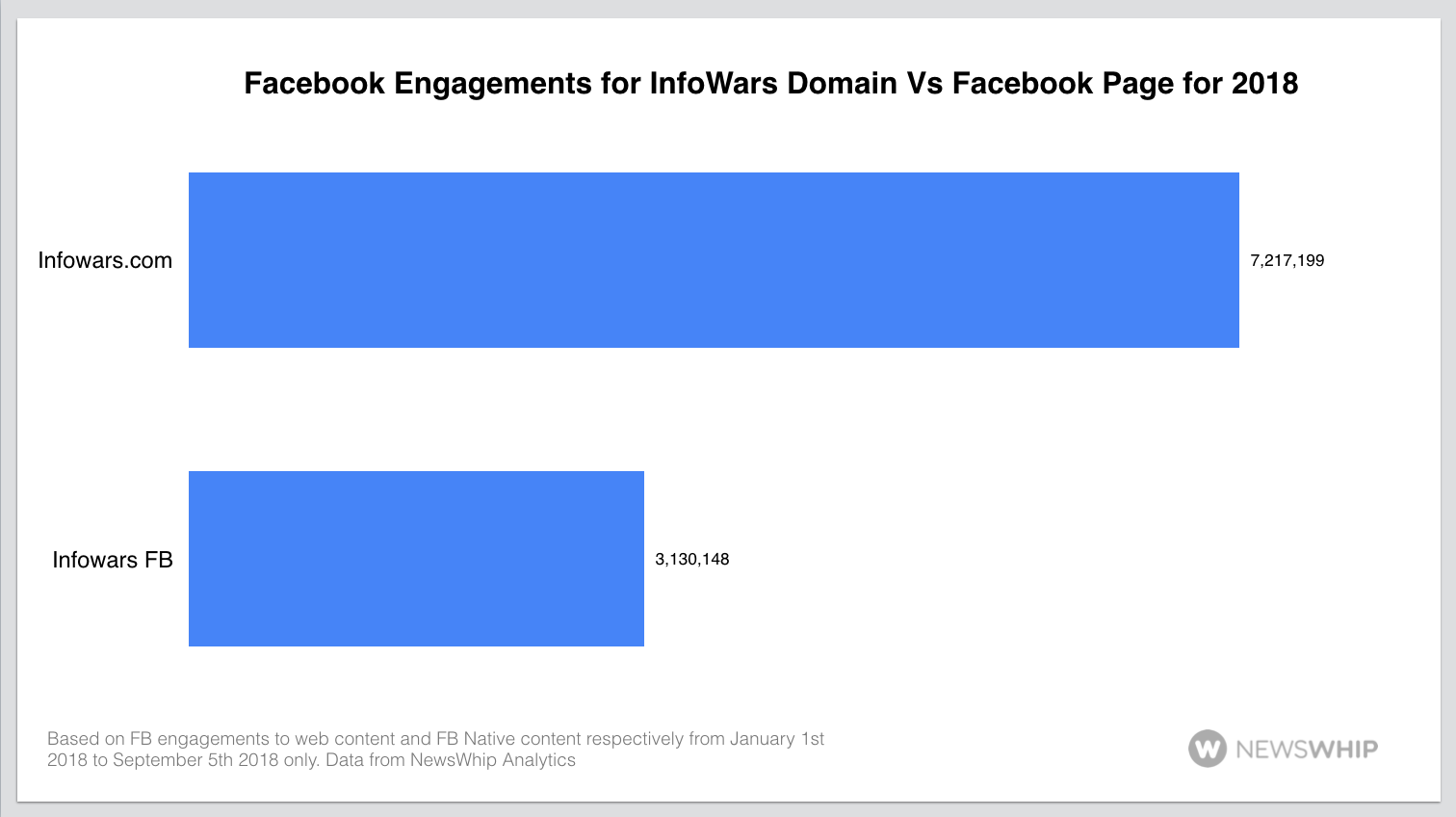
However, when we took a look at the engagements to InfoWars’ domain content and Facebook Page respectively, we found that their website content actually received a far higher number of engagements, with more than double the engagements on its web content than on its native Facebook content for the year to date.
As we’ll see, while the banning from Facebook has been significant, it has not stopped their content from being shared and engaged with by individual users.
As we can see from these graphs, although engagement to the InfoWars Facebook Page fell off throughout the year and was eventually cut off completely, engagement to the web content remained fairly strong even after the ban, with hundreds of thousands of engagements to the content still coming every week.
We examined the time after the ban more closely below:


And below we can see the drop off in engagements from just before the ban to just after.
There is some drop in engagements to the web content, as you would expect given that the site’s Facebook Page is a significant driver of those engagements, but there are still clearly a significant number of engagements coming from individuals and other Facebook Pages.

This same pattern holds true for a number of other websites identified by fact-checking website PolitiFact, but you’ll have to get the full report for that.
There’s also information on the top political publishers among mainstream sites, as well as the top publishers that approach political reporting through a left-wing or right-wing lens.
Interest piqued? You can download the full report here.