
We look at five ways that social publishing could change in 2018, from the effects of Facebook’s algorithm change to the growth of dark social channels.
Just a month into 2018, there’s already been a potentially seismic shift in social publishing as we know it.
Facebook’s announcement that it would be reconfiguring how it ranks content in the news feed made plenty of news of its own. While it remains to be seen how much of this will pan out, there’s already plenty of insight and advice (including on this blog) for content creators looking to navigate the changes.
There are other challenges for publishers and platforms alike. In terms of social formats, video has proven expensive and overly dependent on algorithm changes. On the content side, falling trust, increased partisanship, and the proliferation of malicious publishing actors all combine to create an environment where it is difficult to develop loyal audiences.
Plenty of bright spots exist too. Audiences and traffic from social platforms remains robust for many sites, as well as providing a vital means of putting content in front of varied and new readers. Just this week, the Financial Times’ expose of sexual harassment at a charity fundraiser in London became the site’s most read story of all time, after it was made free-to-read and shared heavily on social media.
A roomful of powerful men. "Hostesses" instructed to wear "skimpy black outfits with matching underwear and high heels."…
Posted by ProPublica on Wednesday, January 24, 2018
For more 2018 predictions and advice, be sure to check out the full NewsWhip 2018 Predictions Report, featuring views from top editors and social media analysts at newsrooms including the BBC, the New York Times, Bloomberg, the Economist, and many more.
1) Algorithm shift: What will the effects be?
Undoubtedly the change with the most potential for significance in social publishing is the effect of the Facebook algorithm change on content visibility. More ‘meaningful interactions’ will be favoured, with comments and personal link sharing presumably making up a lot of those engagements. It seems obvious that certain themes of content will continue to perform strongly on Facebook. For content creators on the platform, best practice dictates that the data allows for guidance. This may most obviously speed up a process whereby Facebook is seen as a platform for certain types of content, instead of a means of reaching a vast broad audience without tailoring the message.
Listening to your audience, figuring out what aspects of your content is best suited to a Facebook audience, and taking to steps to make sure its seen there by the right people, are all very possible with a data-informed strategy.
2) A change in publisher power structure
Related to the algorithm shift, but part of a pattern that’s been in effect on social media for the last two or so years, 2018 could see the year that signals the end of quick wins for viral publishers.
As noted in our review of the most engaged sites on Facebook at the end of 2017, a broad pattern of consolidation legacy publishers has emerged, such as Fox, the New York Times and NBC, with the occasional newcomer scoring a breakout month of interest before sliding back down. It’s true that 2017 was also a year that saw a large number of new names in the top charts of Facebook publishers. But while new viral publishers continue to achieve strong engagements each month, and viral stories, it’s becoming more and more difficult for these sites to sustain momentum.
Tied to this is the idea of trust in publishers and media organisations generally. Trust in platforms and media fell from a relatively low base in 2017, and that is a major problem for both actors. Weeding out dodgy sites looking to capitalise on traffic and misleading headlines is a win for the platforms, and publishers looking to make a genuine connection with readers.
3) Is more laser-focused audience building on social media better?
Here’s one thing that the algorithm changes will likely result in: more interest in using social platforms to help build smaller communities, or audience sub-sections.
NPR, The Washington Post, the Boston Globe and ProPublica are amongst the publishers that have devoted energy to building targeted Facebook groups, with many positive upsides.
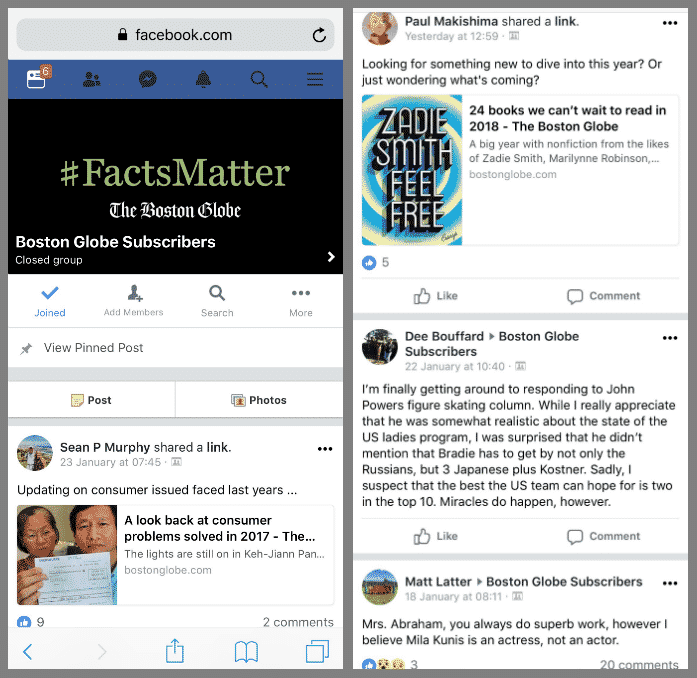
There’s often lively debate and reactions to content in Boston Globe’s subscriber group.
While it’s unlikely that publishers or advertisers will be falling over each other in an effort to devote resources to building strings of niche Facebook and LinkedIn groups, it’s something that may prove more fruitful than continuing to view the large official page as a primary broadcast point. As one U.S. publisher told Nieman Lab last week:
Facebook groups are a way to (build meaningful, authentic relationships with readers), but so is meeting readers in the physical space and intently listening to what questions and concerns the community has.
More focus on smaller groups and communities could be one way of catering to two of the big problems caused by a lack of trust and platforms’ desire to stimulate more conversation amongst users themselves, rather than relying on broadcasts from pages with huge audiences. It’s not just restricted to Facebook, however — WhatsApp, email, Telegram, and more can all be potential gateways to smaller community building efforts.
4) A change in video strategy
On social media, video has been something of an engagement behemoth for the past two years, particularly on Facebook and Instagram. Facebook’s latest algorithm changes explicitly singled out video as a medium which is likely to see an engagement drop. Meanwhile, many of the publishers who have been ‘pivoting to video’ in the last few years have seen their strategy come under fire, as a wave of all-too-familiar clips flooded social streams.
Despite this, video remains a hugely popular digital media format. As a recent Slate article puts it, “given Facebook’s near ubiquity, no other TV or video platform is better positioned to grow via the path of least resistance, since any Facebook Watch video will only be a couple of clicks away.”
While lengths and formats may change, the medium itself is unlikely to completely disappear from feeds. In 2018, how will it change? It could be that they become longer, more original, more immersive, or more sequential. But one thing’s for sure: while video will stay around, a video alone strategy seems to be increasingly risky.
5) New traffic sources
By now, most publishers have discovered that the key to a balanced and sustainable audience base, apart from ensuring a solid user experience and content offering, lies in diversifying distribution channels. Sites have already been making this a reality by developing email strategies, encouraging users to register to read more articles, and tailoring content targeting to suit relevant interests. Those publishers who haven’t figured that out are likely to have a hard time in ensuring that visitor rates don’t decline.
On the other side of this, it’s possible that sites may see bumps in traffic from news directions this year. Publishers have reported decent traffic from Google’s AMP articles in 2017. But perhaps the type of social platform with the most potential in 2018 are messaging apps.
With their entire premise built around peer-to-peer sharing, and a lack of the affordances which spurred on much of the viral and misinformation eras (share buttons, algorithm-powered news feeds, page subscriptions) on social platforms, messaging apps offer an alternative means of viewing information sharing. While it’s certainly not going to look anything like News Feed 2.0, the usage of these ‘dark social’ channels seems set to grow further this year.
To kickstart your social media and content strategy, sign up for a demo of NewsWhip Analytics today.