
Trump or Hillary – even ‘unbiased’ publishers are taking a stance. We investigate the biggest political stories last month and how are publishers driving engagement.
We last looked at political content for May and June. With more tantalizing stories coming out every day, we’d be remiss if we didn’t look at July as well, especially with the Republican and Democratic National Conventions taking place last month.
For this piece, we looked at English-language content published in July 2016 and categorized as Politics in our Spike database. Because of this, this analysis includes both publishers with a broader scope and those which publish exclusively political-themed content.
Top Performing Political Publishers
Breitbart, Huffington Post, and The Hill remained the three top performing political publishers of July. The top rankings were a mix of impartial publishers, and publishers that skew either left or right.
Note that we analyzed these publishers’ political content only. As a result, some publishers may be outperforming other publishers as a whole.

Conservative sites Breitbart, Allen B West, and Daily Caller also made it into the top performing publishers, and Daily Kos and US Uncut represented the liberal side.
[fb_pe url=”https://www.facebook.com/washingtonpost/posts/10153981146162293″ bottom=”30″]
This post from the Washington Post was the highest engaging political article published by an established news source in July. Despite being a traditional (and thus, meant to be impartial) news publisher, the editorial board of the paper took an official stance on the presidential race. Perhaps an emerging trend, WIRED today also made a stance.
The Washington Post article drove over 420,000 engagements on Facebook. Opinionated stories such as this one drove the most engagements across Facebook last month, which makes sense, as users may want to share their own thoughts or like stories in-line with their own beliefs.
Let’s take a look at some of those most engaging stories.
Top Stories are Very Much For or Against Candidates
Looking at which stories drove the most Facebook engagements in July, we can immediately see some interesting trends.
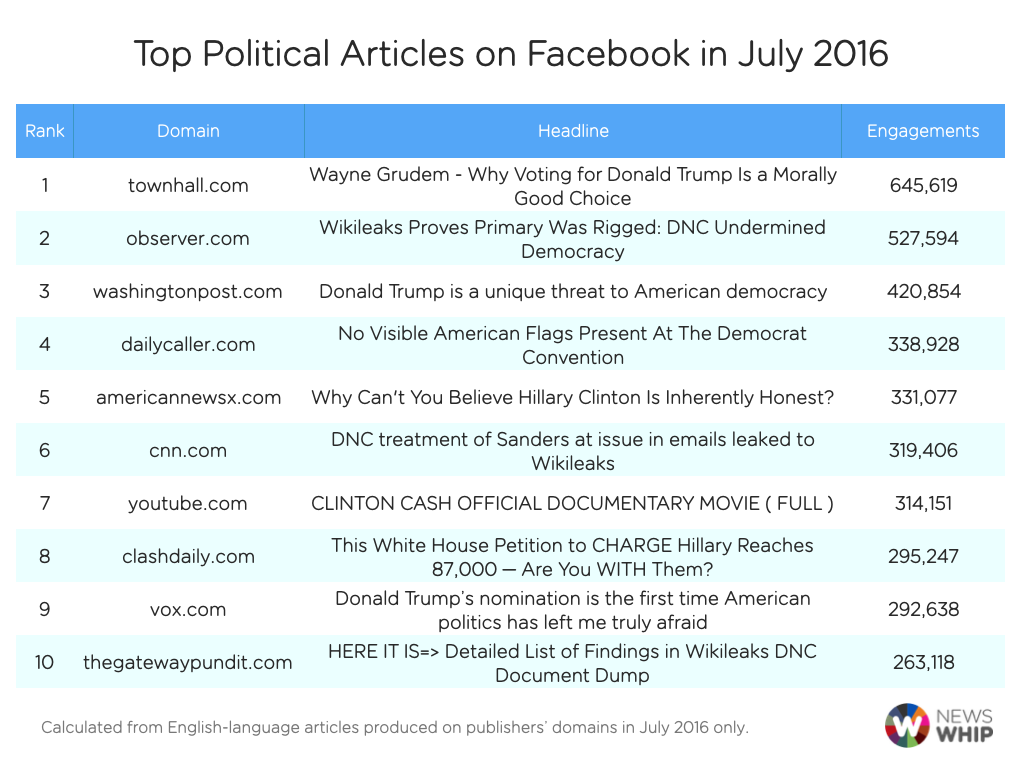
These were the top ten most engaging articles posted in July. The Facebook engagement is calculated through total Facebook likes/reactions, shares, and comments. As we see here, the top articles are extremely divisive.
There’s a clear “us vs. team” mentality at play, as most of these are extremely against or for either the candidate or their party.
Even traditional publishers saw their top articles coming from editorial content or predictions on the candidates and their parties.
Only one of these politically-charged articles didn’t have to do with the presidential race. Seven articles were about either Donald Trump or Hillary Clinton, showing how much the American political atmosphere has come down to extolling the merits and misdeeds of the candidates.
Left? Right? Indifferent? Check out the top political stories trending in Spike
Extreme Publishers Fare Well with Native Facebook Content
As we saw with the top ten articles, publishers and sites that lean heavily left or right also saw big numbers of engagement on native Facebook content. Many of their articles use provocative captions and headlines.
Some of the top pages on Facebook were the Federalist Papers, Qpolitical, The Tea Party, Chicks on the Right, and ForAmerica, all of which lean extremely conservative. Others, like the Political Insider, simply go after both sides with the goal of exposing corruption.
[fb_pe url=”https://www.facebook.com/politicalq/videos/1828451764108601/” bottom=”30″]
This native video from Qpolitical saw more Facebook engagements than the Washington Post editorial piece. An astounding 27 minutes long, the video was viewed over 15 million times, with 95,000 likes/reactions, 12,000 comments, and 468,000 shares.
These high engagement numbers can be quite revealing to publishers about different politically charged audiences. It shows how people react in high numbers to more sensationalistic content and to content that speaks to those with a distrust of government.
Politicians are Social Media Superstars
Distrust or not, politicians themselves drive high engagements numbers on their Facebook pages, with Donald Trump, Allen West, Hillary Clinton, Bernie Sanders, and even Arnold Schwarzenegger.
Oftentimes, these numbers are even higher than the engagement seen by publishers. The Facebook page Donald J. Trump saw over 27.5 million engagements in July, while Hillary Clinton’s drove over 10.8 million Facebook combined likes, shares, and comments.
[fb_pe url=”https://www.facebook.com/153080620724/posts/10157341328900725″ bottom=”30″]
This simple text post from The Donald, following the first day of the Republican National Convention, drove over 1 million total Facebook engagements, with 303,000 shares, 714,000 likes/reactions, and 40,000 comments.
What does this mean for publishers? Looking at politicians’ social media accounts can provide publishers with material to quote that’s already gone viral. It can also allow publishers to monitor what readers’ reactions and engagement around politicians’ posts.
Beyond Election 2016
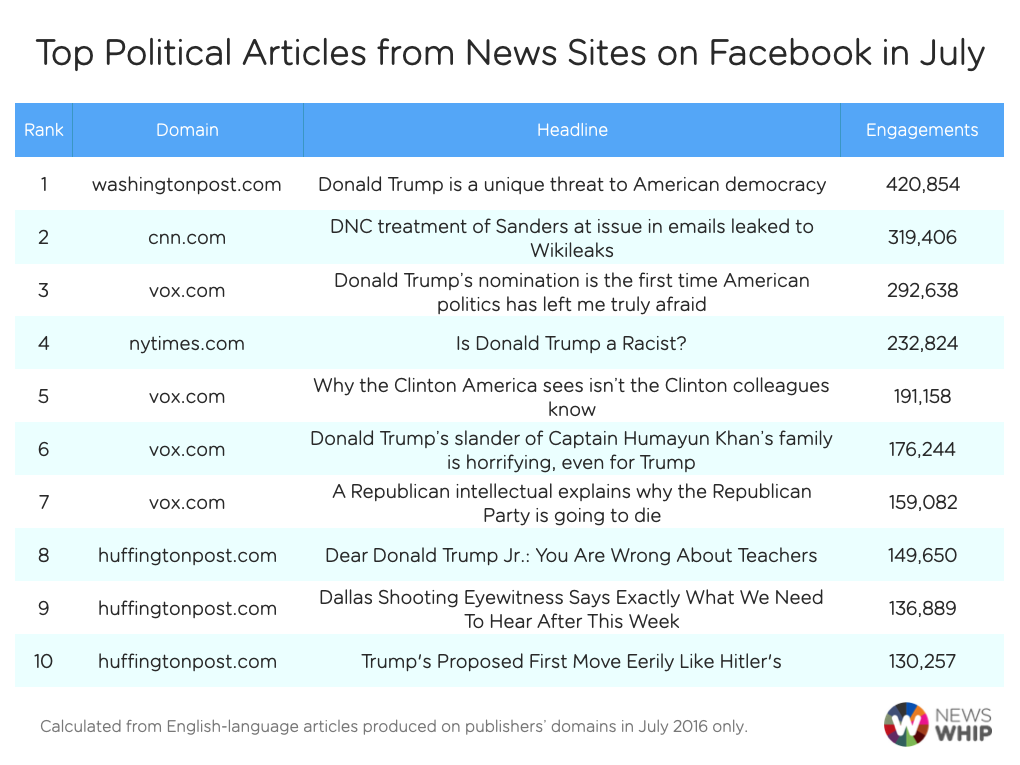
What were the top stories in politics that didn’t pertain to Trump and Hillary? Looking again at the top traditional news sites, we found these top 10 articles posted by the sites in July.
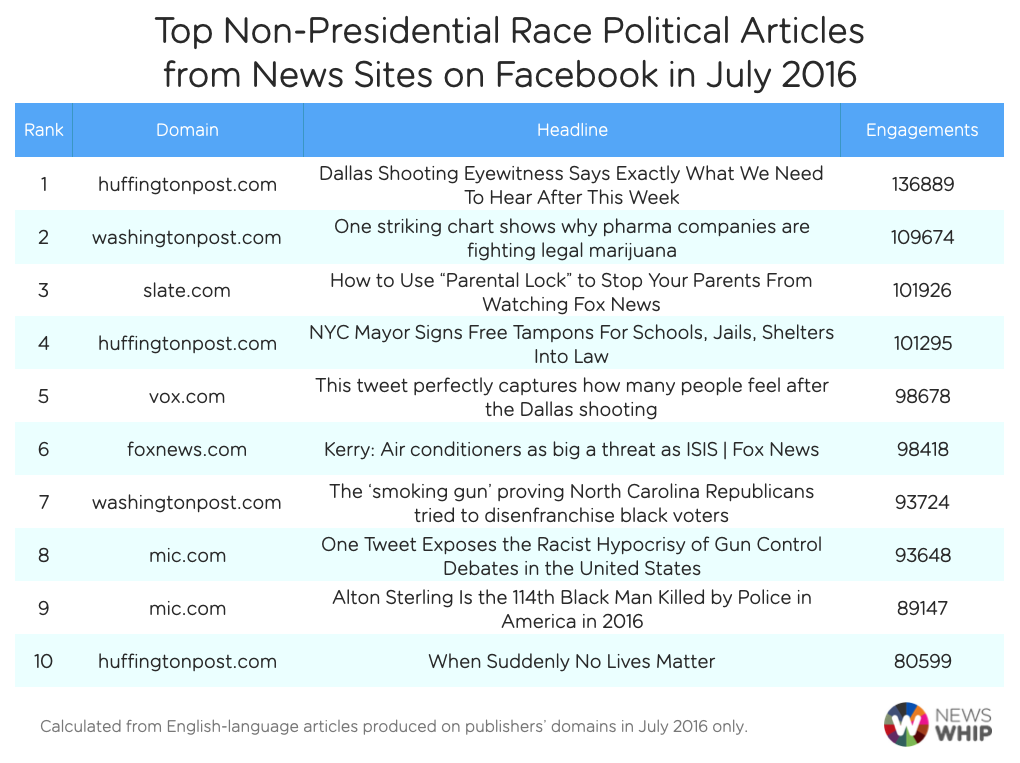
Police shootings, Black Lives Matter, and gun control all made the list. The other top political stories were about marijuana legalization, women’s rights, and the environment, as well as a satirical (sort of) piece about Fox News’ political reporting.
What to Know
The top stories of July show what a historic race this is, beyond the race itself and instead in terms of media and publishing. Even publishers like the Washington Post, meant to be impartial, are taking stances about the candidates.
Extreme media outlets and the politicians themselves are driving strong engagement as the race only gets more intense. With this direct line between candidates and voters on social media, publishers can get a stronger idea than ever about the opinions and views of voters.
While Election 2016 is dominating chatter on social media, societal issues are also seeing significant engagement. Publishers shouldn’t ignore the other political topics that matter to their readers.
As the race continues to reach a boiling point, we’ll be keeping up with the top stories and trends.