
Which publishers in Mexico are seeing the most engagement on Facebook and social media?
Our weekly Facebook rankings are a staple here on the NewsWhip blog, and previously we’ve also explored publishers in France, Sweden, Italy, Germany, and Ireland. This time, we decided to turn our gaze to Central America, and publishers in Mexico.
Thanks to news distribution on Facebook, readers from Mexico can easily come across stories from their national publishers as often as stories from the New York Times and BuzzFeed.
These national publishers have a potential advantage in being able to create content in their audience’s native language and stories that are culturally relevant. Let’s look at how and what those publishers are doing well.
The Top Mexico Publishers on Facebook in Summer 2016
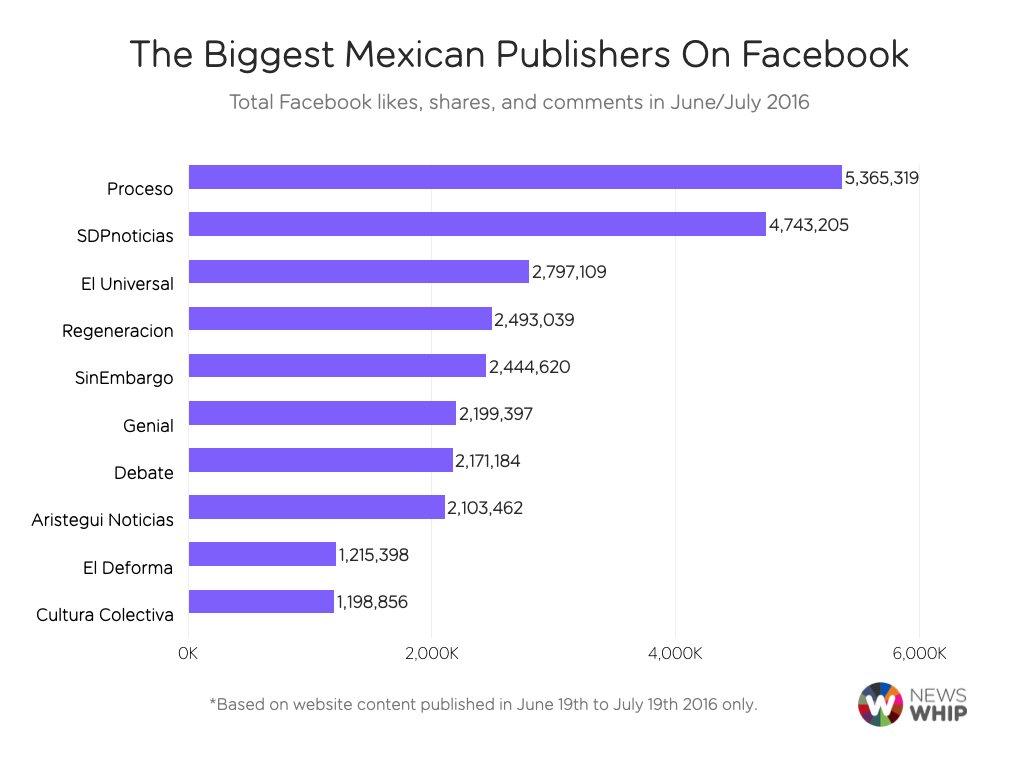
Proceso was our most engaging publisher in Mexico for June, with the most Facebook likes and shares of the publishers we analyzed. SDPnoticias had a slighter larger amount of comments.
Proceso is originally a print publication, focusing on political and social analysis in Mexico, but also covering sports, culture, and other general interest topics.
SDPnoticias is a daily digital in Mexico, and claims to be the most read in the country. Their most-commented article was about a famous v-logger leaving table dancing to pursue religion, which saw over 14,000 comments.
El Universal had the largest amount of articles published, 10,935 to the top ten’s average of 3,614. With more content, there is more opportunity for engagement, so their placing at third isn’t surprising.
Proceso Reveals the Stories That Matter
How did Proceso set itself apart as the top Mexican publisher on Facebook? Many of their top articles reported on both national and international affairs for Mexico, as evidenced by their top five.
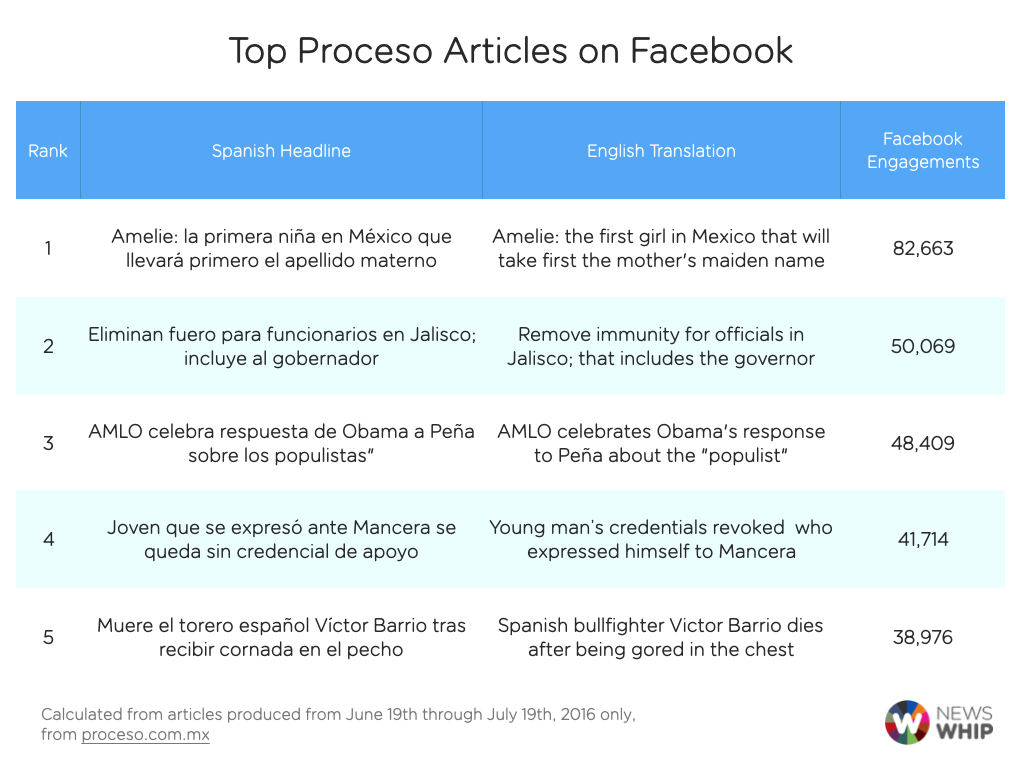
Their biggest story, however, was about the first woman in Mexico to legally have her mother’s surname preceding her father’s surname. It’s traditionally the other way around, with the father’s surname before the mother’s.
[fb_pe url=”https://www.facebook.com/revistaproceso/posts/10154722402892923″ bottom=”30″]
The story drove nearly 83,000 engagements across Facebook, 64,000 likes, 7,100 shares, and 11,000 comments. Stories that affect people’s day-to-day lives or reflect the changing societal norms, can spur hearty discussion on social media.
Looking at a publisher’s top stories can be a good temperature gauge of the stories that matter right now. This analysis can reveal content trends and provide additional fodder for more stories.
Soft News Steals Engagement
Despite Proceso having the most overall Facebook engagements, Genial had the three biggest stories. Genial, meaning great or brilliant, is a digital native, similar to publishers big on Facebook like LittleThings.
[fb_pe url=”https://www.facebook.com/GenialGuru/posts/1698140280507113″ bottom=”30″]
Their story, “11 Hábitos que aceleran tu metabolismo”, a listicle on habits that speed up the metabolism, saw over 132,000 total Facebook reactions. Their second top article was also a listicle, while the third was a slideshow of motivational phrases.
Genial also had the most commented article, a riddle called, “Este acertijo de niños confunde incluso a los adultos”. Gamefied and interactive content see engagement results for publishers. This one saw over 21,800 comments on Facebook.
The Biggest Stories of July
Looking at the top 20 articles, there are a wide mix of topics. As we noted before, life-related articles from Genial account for the top three, but harder news topics made an appearance as well.
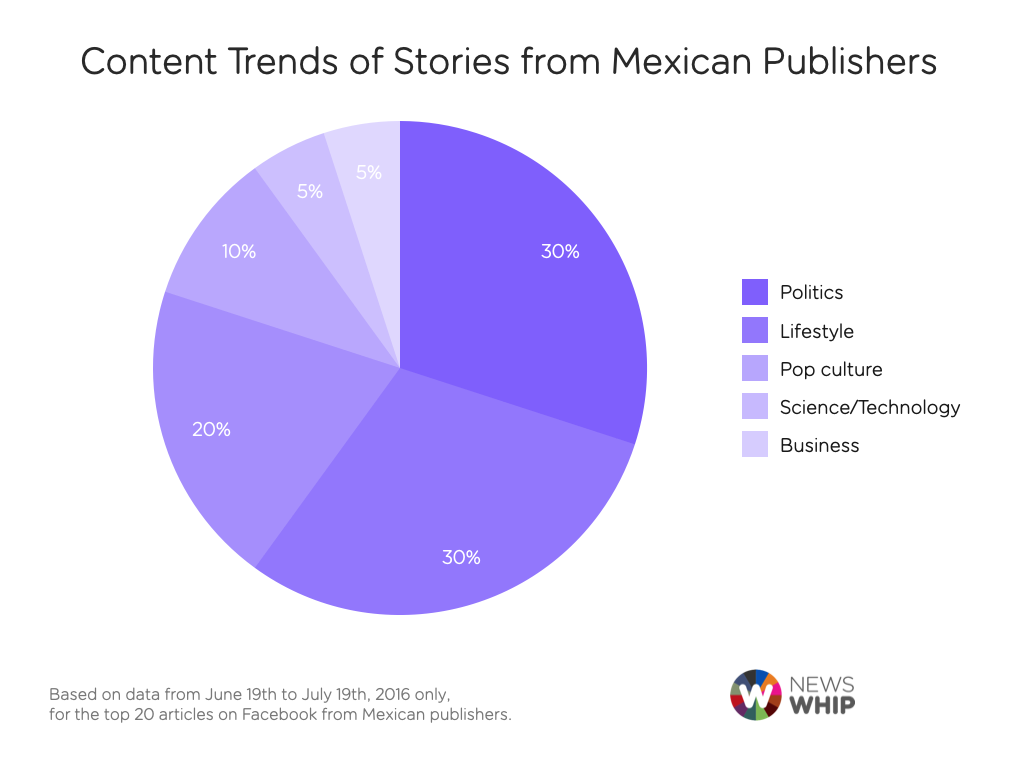
Half of the top articles are about softer topics, including culture, life (fitness, beauty, human interest), celebrity gossip, and technology/science.
Six articles were about politics, and half of those were about Mexico’s neighbors, either the United States or Canada. In fact, Obama appeared three times in the top 25 headlines.
It’s interesting to see such a diversified range of stories but equivocal levels of engagement, instead of one category of content dominating the chart.
Going Native
While these country natives do quite well, other publishers are creating content for the Latin American market, including Mexico.
BuzzFeed has launched a variety of global verticals, such as BuzzFeed Mexico, and learned to tailor their content to the country’s sense of humor.
[fb_pe url=”https://www.facebook.com/BuzzFeedMexico/videos/1349280085087716/” bottom=”30″]
This live broadcast of Mexican Youtube star Mario Bautista answering viewers’ questions drove 39,000 likes and reactions, 37,000 comments, 1,500 shares, and was viewed over 324,000 times.
Huffington Post and CNN each have LatAm sites that cater to the whole region. We spoke to CNN en Espanol recently, who is getting up close and personal with their Latin American audience. They told us their team uses two brand new broadcast trucks dedicated to getting stories on the ground.
“When you go to cover a story anywhere in the world, the reaction of people is amazing,” said Juan Andres Muñoz, CNN en Espanol’s head of social media and digital.
What to Know
As we’ve noted in our guide for brands with a global presence, it’s vital to know what will appeal to the local audience. What seems like it’ll resonate everywhere, might not be popular to certain cultures or regions.
Using social signals lets you stay ahead of the stories taking off region by region, as well as the tone, format, and tactics of the most successful content.
Try Spike to spot the trending stories in your country, region, or even city today