
We explore what fashion communicators can learn from the key authors at Fashion Month.
Recently on the blog, we took a look at the growing importance of influencer marketing. One industry in which influencer marketing is key is fashion. As we’ve seen in previous blog posts, leading figures can have a phenomenal impact on campaigns and coverages. How then can fashion communicators incorporate this in their own content?
Using NewsWhip Analytics and Spike, we took a look at coverage of Fashion Month and analysed the key insights, authors, and influencers. For the purposes of this article, we looked at content published between February 11th and March 9th, a period which took in major Fall/Winter shows in New York, Milan, Paris, and London. “Engagements” in this context means the combined total Facebook likes, shares, and comments or combined total Instagram likes and comments, where appropriate.
Overview
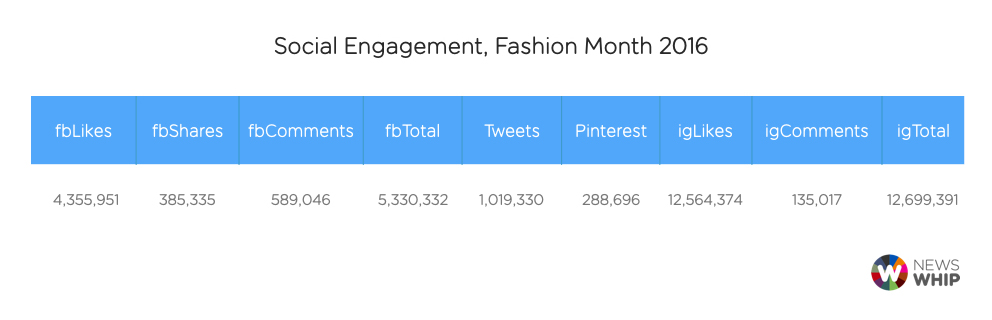
As one of the biggest periods in the fashion calendar, Fashion Month drove colossal engagement. Our data shows that content mentioning “fashion week” spurred 5.33 million FB engagements, 1.02 million tweets, 288,696 pins and 12.7 million Instagram interactions. The following table shows a breakdown of engagement generated by Fashion Month content across different channels:
Breaking down the data further, we can identify how engagement with content evolved over the course of the month. The following graph from NewsWhip Analytics illustrates this for Instagram:

Straight away, we can see that engagement was highest early on in the month. This suggests that coverage of New York Fashion Week elicited a greater response than subsequent Fashion Weeks. Analytics also lets us see whose content generated the most interaction.

This shows a varied mixture of influencers. Models and public figures such as Karlie Kloss generated huge engagement on their posts, while Vogue remains the leading fashion publication based on Instagram interactions. Fashion and make-up brands also gained a strong following – Forever 21, TopShop, and MAC each claimed a significant share of voice during the month.
Authors and Influencers
Following on from our blog last month, Vogue (US) remains the most engaging fashion publication on Instagram. The magazine’s coverage dominated the platform during the month, with many of the top Fashion Week stories originating on its feed. Several Vogue contributors appear in Spike’s breakdown of top authors for the month. Janelle Okwodu and Steff Yotka were the leading authors, with their articles driving a combined total of 120,134 Facebook interactions. A breakdown of the biggest posts reveals that audiences responded to a diverse range of stories. List-oriented articles are a perennial favourite on Facebook, but more analytical coverage also resonated with users.
![Fashion week authors = Vogue contributors [3]](https://www.newswhip.com/wp-content/uploads/2016/03/Fashion-week-authors-Vogue-contributors-3-1024x503.gif)
Looking at Vogue’s Instagram feed in Analytics, we can see that Kendall Jenner and fellow models Gigi Hadid and Taylor Hill appear in several of the biggest posts for Fashion Month. A behind-the-scenes video of Jenner generated 175,281 total engagements on Instagram – significantly more than the original post on the magazine’s website. Vogue also uploaded a series of posts documenting Hill’s experiences at Paris Fashion Week. Combining sleek black-and-white photography with the model’s candid insights on the industry, each of these posts generated over 100,000 interactions.
Learnings
What can fashion communicators learn from these insights? Firstly, the influence of celebrity names and culture is massive in fashion. This is something we’ve noted previously, but well-known figures and personalities can provide a focal point for users amid a plethora of Fashion Month coverage. Candid photos and behind-the-scenes snapshots help to personalise the events and prove particularly alluring.
Analytics data also shows that user interest spikes early in Fashion Month – but engagement remains keen over the ensuing weeks. The above breakdown of engagement shows clear increases in activity around dates in London and Paris Fashion Weeks and indicates that fashion audiences are highly engaged, consistent and dedicated.
Finally, Instagram remains the dominant platform for fashion coverage. The channel’s mixture of aspirational content and accessibility is a golden ticket. Visuals – especially in this highly stylised industry – are often enough for users, with little context needed for backstage videos and runway shots.
Stay tuned for more fashion coverage on the blog soon.