
NewsWhip’s Head of Marketing, Kevin Twomey, recently took part in a panel hosted by PR firm Red Consultancy, alongside corporate comms leaders from Lidl and Caffè Nero. The event focused on a challenge that every communicator knows all too well: what to do when your brand is at the center of a crisis. The discussion was centered around one idea—how to flip the script and reclaim the narrative.
Here are five takeaways from the conversation.
1. Start with your values and priorities
When a crisis hits, the noise can be overwhelming. The instinct is to respond to every comment, every headline, every social media post. But the truth is, you can’t fight every battle.
That’s why clarity on your company’s values and priorities is so important. If the CEO and leadership team have alignment on what the business stands for, you immediately have guardrails. Those guardrails make it easier to decide what to engage with and what to let pass. The outdoor apparel brand Patagonia is the best (and rightly the most overused) example of a company with clear values that directly influences what they speak out on. The company’s mission is about ‘saving our home planet’ and they back this up by donating one percent of sales to grassroots organizations that are helping to protect the planet. They have very clear values that further support their mission and make it easy for the comms and leadership team to decide what to speak out on and what to avoid.
Having a mission and values as clear cut as Patagonia might not be possible for every company but it shows the power of understanding who you are as a brand and how that can influence when you speak out or, often even better, say nothing at all.
2. Use history as your compass
History doesn’t repeat itself, but it often rhymes — which is why NewsWhip clients study past brand crises to spot predictable patterns that prepare them for the moments when they’re in the storm themselves.
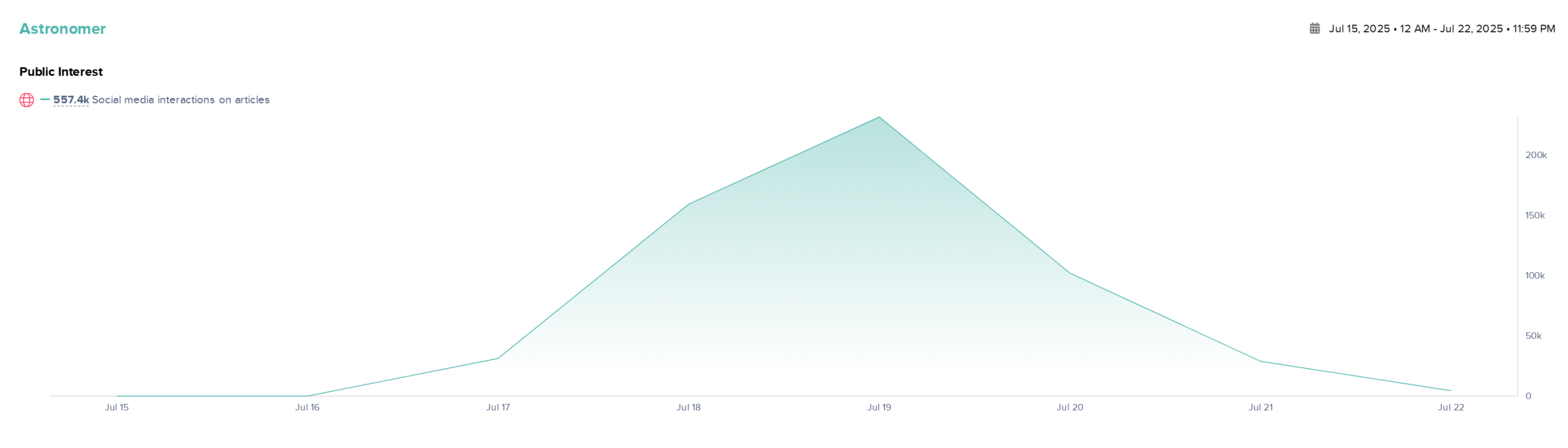
The two patterns we see most often are the typical ‘A crisis’, a sharp increase and decrease that usually spans 3-5 days. This Summer’s Astronomer kiss-cam scandal was a perfect example of this, with a peak in public interest on the day the former CEO announced his resignation.
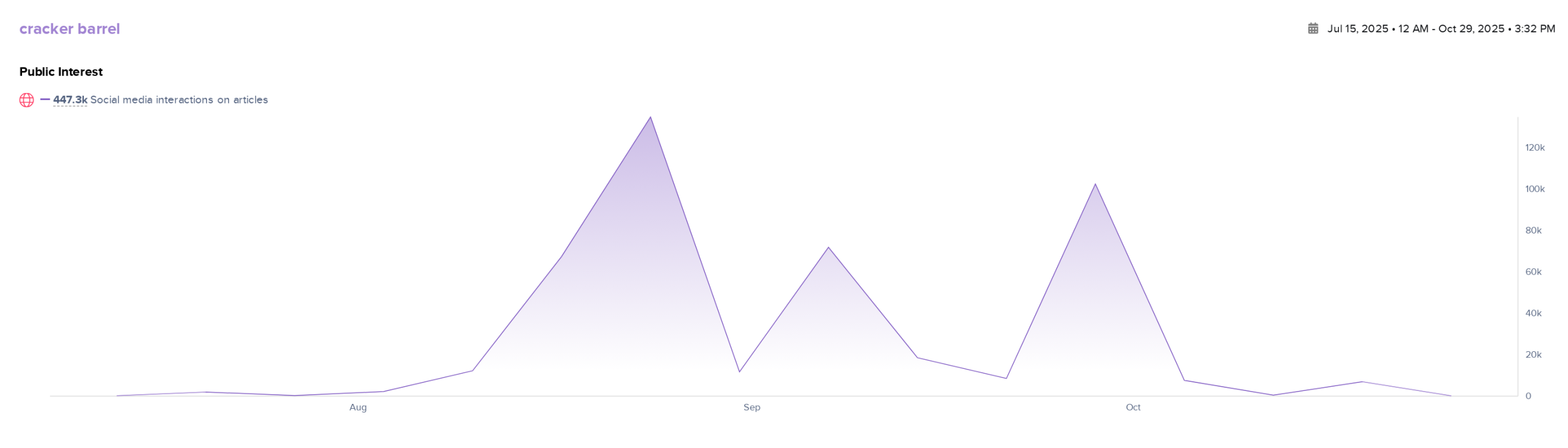
The second pattern we see most often is the dreaded ‘W’, a triple header of an issue, where there are 3 spikes in media or public attention lasting up to a week.
The recent Cracker Barrel re-branding had three distinct peaks in public interest
- Spike 1: The re-brand is announced sparking MAGA backlash
- Spike 2: Cracker Barrel cancels the re-brand, reverting to the old logo
- Spike 3: Cracker Barrel announces that it’s fired the consulting firm behind the rebrand.
Unfortunately the brand found itself in an impossible situation, where every step was a misstep and likely rooted in a lack of clarity around what they stand for and who their audience is.
To prevent an ‘A’ turning into a ‘W’ you need two things. First; deep pattern recognition of historical issues so you can quickly go from hindsight to foresight. And second; automated monitoring and detection to notify you as soon as interest levels start to tick back up. We’d advise all our clients to enable NewsWhip’s AI Monitoring Agent for any live issues so they’re made aware of any geographic spread, change in interest levels or any new articles that are predicted to increase in engagement levels.
3. Understand the fragmented media landscape
The media landscape today is more splintered than ever. A decade ago, a comms team needed eyes and ears on just Facebook and Twitter. Now, there are six platforms delivering 10%+ of weekly news consumption (Source: Reuters Institute).
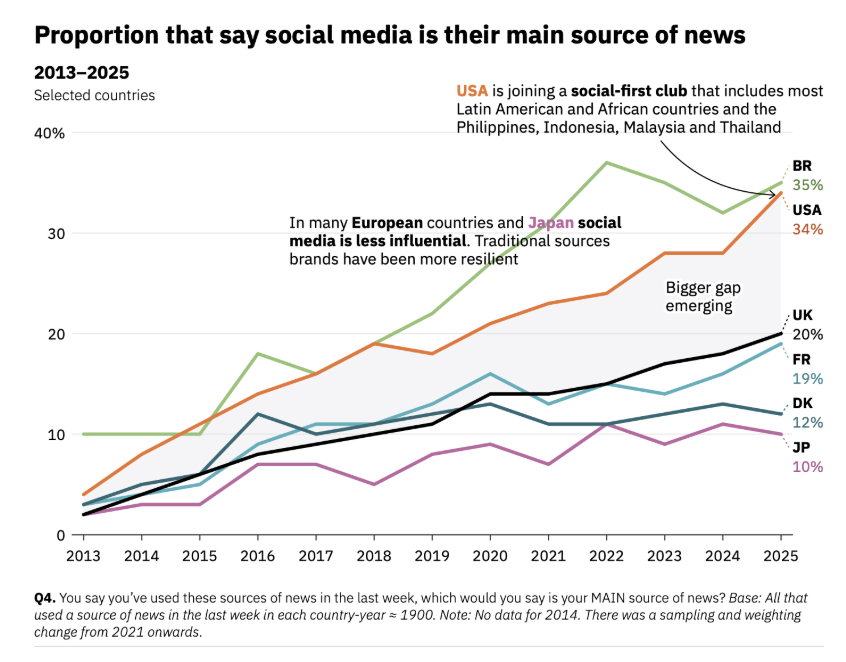
This hyper-fragmentation means each social platform can function like its own ecosystem, with its own audience, its own tone, and its own hot-button issues. What’s trending on X might be invisible on Reddit, and vice-versa.
As a brand, you can’t afford to treat “the media” as one uniform block anymore. You need to understand where your audiences are, who they trust, and how conversations differ across platforms. With your agreed upon set of values and priorities you can then decide which battles are worth fighting on which platforms, if any.
4. Don’t just do something; stand there.
One of the strongest instincts in communications is to respond quickly. After all, no one wants their brand to look unprepared or unresponsive. But sometimes, reacting too fast can actually make things worse.
This is where technology can really help. At NewsWhip, our real-time predictive intelligence lets brands see not only how big a story is right now, but how it’s likely to grow in the hours ahead. If the data shows that the story is already fading, the best move may be to hold your fire.
Having up-to-the-minute data that shows you the future trajectory of a seemingly burning issue makes it a lot easier to convince your CEO on what to do next. There is great power in being able to say ‘look at this graph, the story will be old news come tomorrow, we don’t need to react’.

That moment of restraint can save your brand from pouring fuel on a fire that would otherwise burn out quickly.
5. Build relationships with the new storytellers
Finally, one of the biggest shifts we’re seeing is the rise of independent news creators and influencers as trusted voices. In the UK, over half of 16–35 year olds now consume daily news from influencers (Source: IPSOS). These news creators have built loyal followings by speaking directly to their audiences, and those audiences often trust them more than traditional media.
For brands, this is both a challenge and an opportunity. You can’t control these creators, and you shouldn’t try. But you can build trust with them over time. That means engaging with them on their terms, respecting the audiences they’ve built, and finding ways to collaborate authentically. We’re seeing brands and institutions fully embrace news creators as a vehicle to get their message out to a highly sought after audience. Take No. 10 Downing Street as an example who in July invited up to 90 creators with a combined following of a quarter of a billion for a reception behind the famous black door. The Labour Government knows that if it’s to “go where people are” then they need to embrace a new type of media.
If one of the world’s most recognisable and risk-averse institutions is embracing news creators then so too should high-street brands.
Final Thoughts
Crisis moments will never go away. What matters is how prepared you are, and how well you can keep perspective in the heat of the moment. For me, the panel reinforced a few truths: clarity on values, context from history, understanding the landscape, the discipline to pause, and building trust with new storytellers.
If you can keep those five principles in mind, you’ll be better equipped not just to survive a crisis, but to flip the script and emerge stronger.
At NewsWhip, we’re committed to giving communicators the data, insights, and confidence they need to make those tough calls. Because in the end, the narrative belongs to those who know how to shape it.