We’re entering a new phase in artificial intelligence. If you work in any industry that’s even vaguely tech-adjacent, it’s likely you’ve heard 2025 being referred to as “the year of the agent”, so what’s that all about?
The first wave of AI was about chatbots and generation. The next is, for want of a better term, about agency.
The focus is shifting from systems you prompt, to systems to which you delegate. These systems, agents, don’t need constant instructions. They pursue goals. They monitor, they interpret, and they act.
Every major foundation model company is betting on this shift. OpenAI, Anthropic, Google—all are building toward an agentic future.
What are agents, and why now?
There’s a lot of confusion about the term “agent.” Let’s define it clearly.
An agent is not like the AI tools you were playing with in 2024.
An agent is:
- Given a goal, not a one-time prompt
- Able to decide how to achieve that goal
- Designed to act autonomously, repeatedly, and adaptively
- Persistent, running over time, not on-demand
Why are agents viable now? Because four long-standing technical barriers have quietly disappeared:
- Reasoning: LLMs can now make structured decisions, not just generate text
- Context: Models can process huge input windows (up to 1 million tokens)
- Memory: Systems can now retain brand preferences, tone, past decisions
- Cost: Infrastructure and model design improvements have made persistent agents economically viable
This unlocks something new: software that doesn’t just answer questions – but acts to solve problems and achieve goals.
What this means for communications
PR and comms professionals live in a high-stakes, high-noise environment. The volume of content is exploding. Threats can emerge in minutes, narratives can change in seconds. There’s never been more noise in which to try and find the signal.
Traditional monitoring tools aren’t built for this. They’re slow, they’re clunky, they’re broad. And now comms teams that have seen no growth in headcount and have less time than ever have more platforms to monitor, more issues to track, and more threats to assess than ever before.
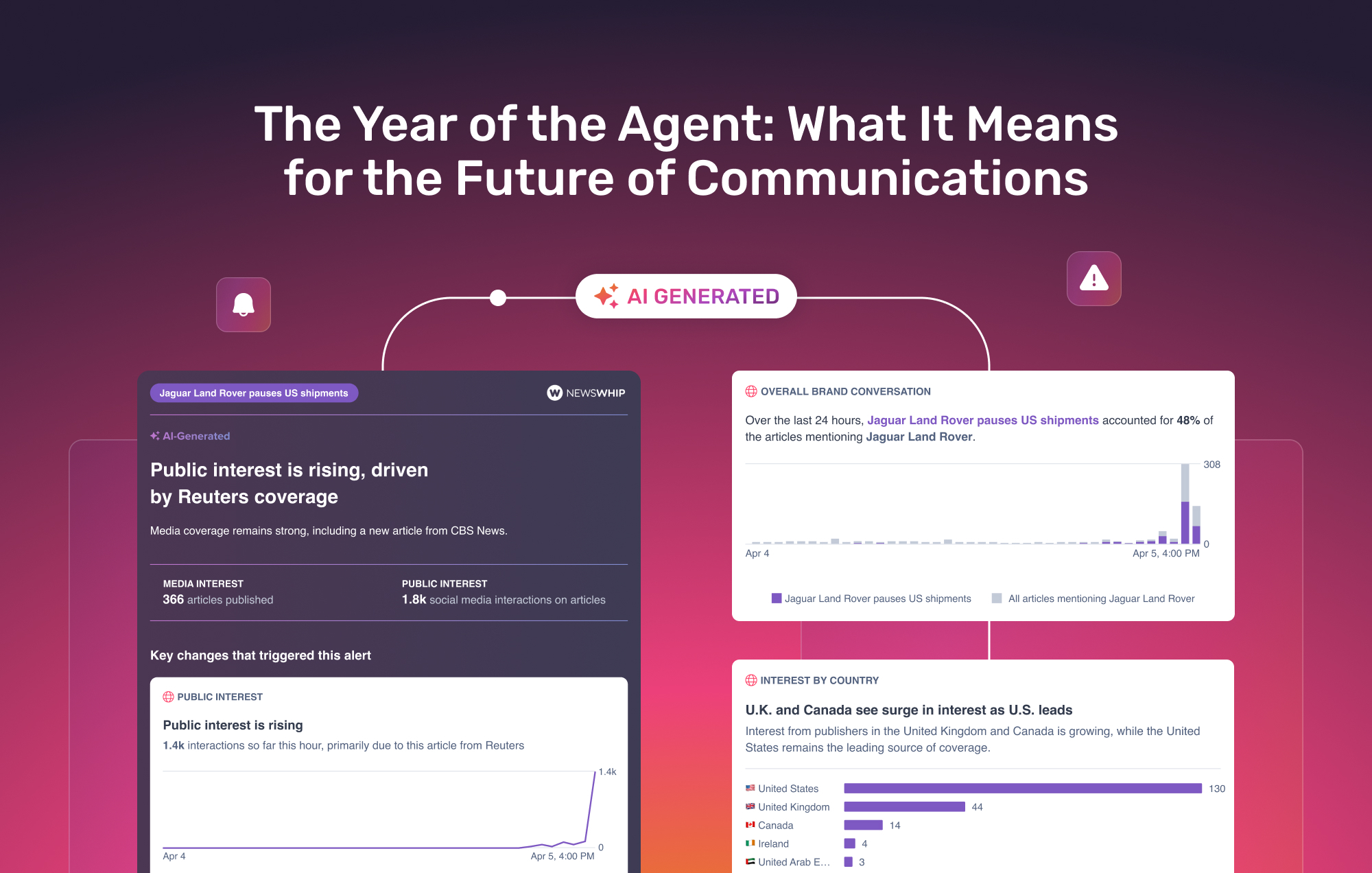
AI agents facilitate that work. They don’t just alert, they investigate. They understand the context. They make judgments about what matters. And when something serious is happening, they come to you with the full picture: here’s what’s going on, here’s how it’s evolving, and here’s why you should care.
That’s what the shift to agents enables. Not just faster response. Smarter response.
What agents enable for comms teams today
AI agents are only just beginning to come to comms teams, but here’s where they can already make a difference. They’re able to:
Expand the realms of what’s possible
No team can read every article. No one can track 40 narratives across regions and channels without missing something, but agents can. This isn’t about doing the same work you were doing before, it’s about doing what was never possible manually.
Deliver brand-specific intelligence
A useful agent doesn’t just summarize. It knows what “positive” looks like for your brand. It understands tone, headwinds, opportunities, risks—and filters accordingly. Not every spike matters. The right agent knows the difference.
Offload repetitive analysis
Sentiment tagging, issue clustering, spike investigation—these are high-effort, low-judgment tasks that drain attention and take a lot of time. Agents can handle them continuously, without fatigue, and without missing a 4:00am spike.
This is more than automation. It’s a shift in how information gets turned into action.
Transforming comms workflows
The model most teams use today is real-time triage. That means scanning dashboards, reading alerts, then deciding what matters and escalating as needed.
Agents make a different model viable: hands-free, asynchronous monitoring.
Instead of constantly refreshing a dashboard, you let an agent do the watching. When something meaningful happens, it doesn’t just notify you, it explains why it matters. It delivers a briefing, not a ping.
That leads to fewer interruptions, better context, and more space for actual decision-making and effective responses.
Building trust and autonomy
With all of this, trust is everything. You wouldn’t hand the keys to a new hire on day one, and the same logic applies to AI agents.
We’d always suggest people slowly integrate agents in parallel with your existing systems. Watch how they perform. Build confidence before you rely on them completely. Let agents run alongside existing processes and compare what they flag to what your team sees
Then, once you’re confident they’re replicating the tasks you need them to successfully, let them do it autonomously.
Grounding in data
An agent is only as useful as the data it’s built on.That’s especially true in comms, where signal quality is everything amidst so much noise.
To add value, agents need:
- High-integrity, real-time data
- Brand-safe reasoning, not just surface-level summaries
- Narrative awareness, not just keyword triggers
- The ability to say, confidently, this spike doesn’t matter
At NewsWhip, we’re focused on building agents that aren’t just technically impressive—but genuinely useful in real comms workflows. That means grounding them in meaningful data, not just feeding them what’s trending.
What’s next – and where to start.
This isn’t about being early, it’s about being ready to take the first step on the journey. As artificial intelligence capabilities improve, workflows will transform and give everyone more time back to do strategic work.
If you work in comms, this is the moment to lean in. Teams that integrate agents into their workflows now will get a head start and have more time, more clarity, and more context, and we’ve just launched our own for you to try, which you can read about here.
The year of the agent isn’t about replacing people. It’s about augmenting them, and giving communicators the tools they need to do their jobs faster, better, and smarter.
You can learn more about NewsWhip’s AI Monitoring Agent here.