
How can publishers and content creators instill trust with their audiences in the age of social distribution, and why is it important?
Does your audience trust what you have to say?
In the wake of Facebook’s decision to rethink the news feed, and questions around the role of social media in propagating misinformation and low-quality content, the issue of trust in digital media seems to have reached a critical tipping point. There are many factors that influence how audiences feel about trusting the media. But combining all those factors, trust it seems, is as low as it’s been in a long time.
Consider the results of two reports on the public’s trust in media. The Reuters Digital News Report for 2017 shows a public split along preferred media sources, with hyper-partisan sources filling a gap in news provision where trust in legacy media outlets has fallen.
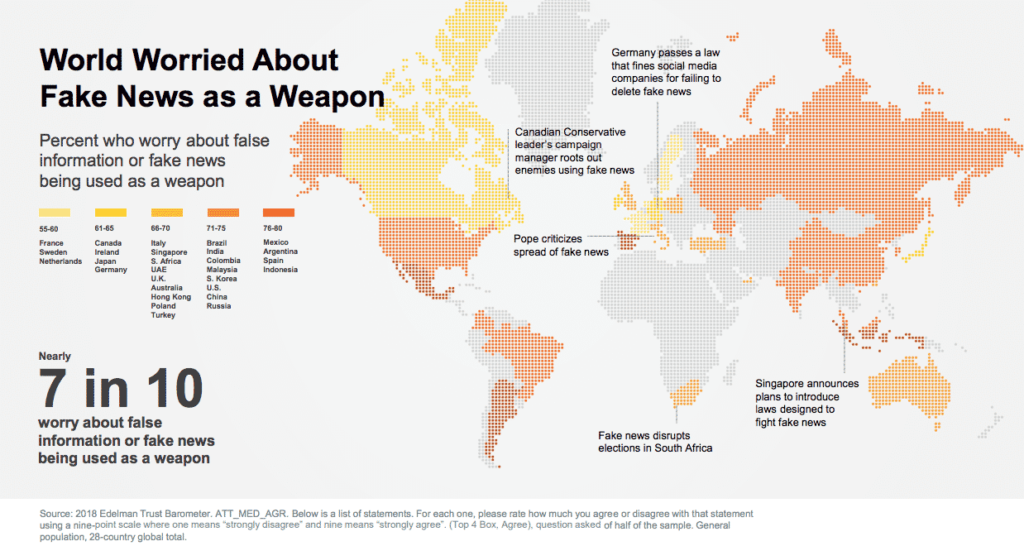
The second report, Edelman’s public trust barometer, shows a picture of polarisation on the topic of trust.
“For the first time ever there is now a distinct split between extreme trust gainers and losers,” the report outlines. The U.S. saw almost 9 percent drop in trust in the ‘institutions of government, business, media and NGOs’ over 2017, while 63 percent of respondents globally claimed that they were unable to tell good journalism from rumour or falsehoods.
Additionally, the Edelman report indicated a growing distrust of platforms themselves as a form of media. While global trust in search and social platforms surpassed trust in traditional media in 2015, the trend has since reversed, and trust in platforms has declined since.

Why is it important to think about ways of reversing this trend? Simply put, in order to thrive online, there’s a need to be transparent when it comes to developing a relationship with readers. Whatever the subject matter, providing a genuinely useful and enriching product to your audience is crucial to long-term success.
As NewsWhip data and recent platform announcements may have indicated, 2018 could be the year that signals the end of quick wins for viral publishers in terms of visibility.
But gaining trust online goes further than just reducing the visibility of the actors that deliberately mislead. It requires publishers and platforms to hold themselves to a high standard.
Platforms themselves understand this fundamental difficulty that their feeds face. In order to stay interesting and actively used, they need to make inroads in policing what is allowed to spread in their feeds. The results of this multivariate process are yet to be seen.
For one thing, it’s probably true that the days of consistent easy traffic from social platforms are finished. That’s not necessarily a bad thing, given that that helped create an ecosystem where those very trust problems were exacerbated in the first place.
Publishers are left to navigate difficult terrain. Having no influence over the content that may appear above, below, and around their own posts on social platforms, it’s quite possible that individual media brands assume the collateral damage of falling levels of trust in platforms. So, what can be done, outside of hoping for a solution from the platforms that will somehow magically solve everything?
How can publishers build trust with their readers?
Clearly, there is work to do on both sides, publishers and platforms. Much of this work is complimentary.
It involves creating an environment where users feel as though the content that they see can be trusted, and that their engagement with that content — through commenting on a post, sharing it with their friends, or simply just clicking through to read more — is not just seen as an anonymous metric to be monetised.
Platforms with significant media interests have started to take steps to attempt to address this divide.
Facebook has announced that a ‘trust survey’ will form part of their efforts to increase the visibility of local news sources, and less clickbait, in the news feed. These measures will inevitably face scrutiny. Interpreting a bipartisan measure of ‘objectivity’ in the media is not a straightforward task. And that’s even before the argument for increased algorithm transparency is considered.
But that doesn’t mean that the content creators should wait until the platforms have designed their own measurement of trust. For publishers, or any page sharing their own content with a view to engaging an audience, getting started or revamping community engagement strategies, and nailing down best practices are good places to start.
There are other seemingly obvious factors that can help boost trustworthiness on the site itself. Consider some of the factors tested as indicators of trust by researchers at the Center for Media Engagement. Simply by including the writer’s title and contact information, labels of the type of story (‘analysis’, ‘opinion’, ‘news’), footnotes with more reading materials, helped increase evaluations of the site overall.
Other possibilities include “Behind the Story” sections that described why and how the article was written, including sources and a reference to best practices, as well as links to the site’s policies on ethics and corrections.
Some publishers will have an advantage already, as previous research indicates that the majority of ‘most-trusted’ news sources are legacy outlets. But that doesn’t mean that newer digital native brands can earn the trust of their target audience.
Largely, this means developing a closer relationship with the reader. While social media changed the news media in many ways, and not all positively, one fundamental shift came in bringing audiences closer to the news-making process itself. The phenomenon of the one-way broadcast as the beginning and end of the story has been removed, and is not going to return.
Journalists, marketers and content creators have largely embraced this new era — think of live-stream Q&As with reporters, and crowdsourced video and content suggestions — because they see it as enriching, rather than detracting from, their output.
But audiences on social networks will remain an important access and distribution point for most publishers for some time to come.