
A slew of new partisan political sites has gone viral in 2017. What do they have in common?
The year since the U.S. election has seen more attention than ever on the links between politics and social media. Social platforms are no longer just marketing add-ons for political campaigns or vectors for sharing with close family and friends. News feeds and timelines have deepened their capacity as the place where political news breaks and spreads, and views are formed and hardened. Publishers have been part of that process.
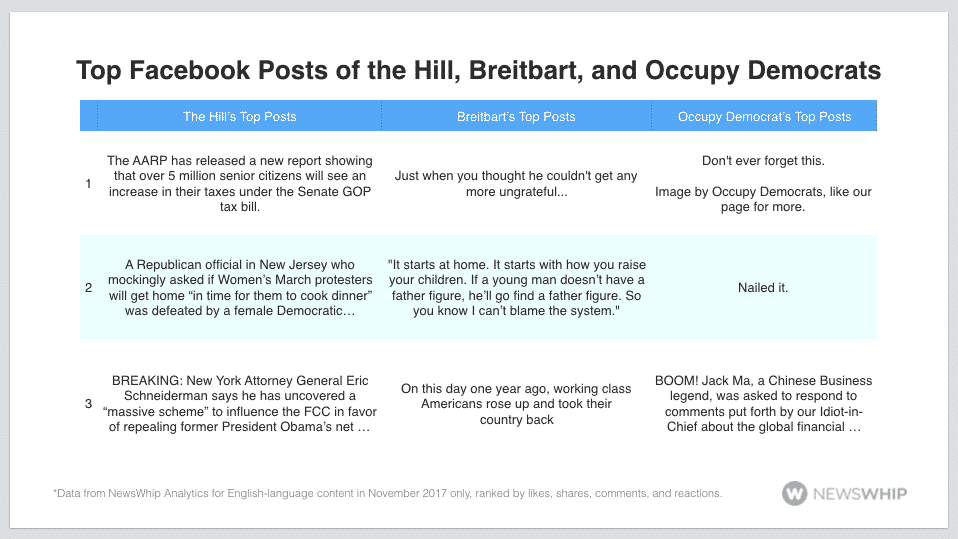
Large conservative political sites such as the Daily Caller and Breitbart have managed to consolidate their positions on Facebook, reaching large audiences with their content each week. Another social politics success story has been The Hill, whose goal of providing nonpartisan coverage of Washington seems to have helped their social numbers grow steadily in the aftermath of the election campaign.
Legacy media have also seen some continued success in the area of politics on social. In October, a New York Times news story about the FBI’s Russia investigation was one of the most popular stories on Facebook, with hundreds of thousands of engagements, while CNN, Fox News, NBC News and other mainstream media outlets have all had political coverage front and centre of their social strategies throughout the year.
https://www.facebook.com/nytimes/posts/10151362810589999
But beyond these sites, there is another strain of hyper-viral political publisher which has flourished in U.S. Facebook news feeds over 2017. Hyper-partisan headlines that scream at the reader no matter what the story, these sites seem to have co-opted many of the tricks learned by early viral publishers with their direct appeal to curiosity, outrage, or identity.
These political publishers have more in common with earlier viral sites that looked to appeal to specific demographics (parents, animal-lovers, college students) than they do with more orthodox media outlets. Their target audience, of course, is the hyper-partisan strand of the US’s electorate.
New political sites have flourished on social media since around 2014, when sites such as the Conservative Tribune started seeing significant engagement growth in news feeds. These sites aimed to cover politics from a particular perspective in a social-native voice, and saw much success throughout 2014 and 2015.
But now, new sites are popping up with remarkable frequency. For the large part, you’re not likely to recognise their names.
In October, a site called ‘Verified Politics’ had just over 12 million engagements (likes, comments, shares, and reactions) on the 754 articles they published that month. The liberal site’s mission statement is to ‘bring you fast, accurate reporting on the political news of the day’.
Its headline style reads like Politico-meets-Shareably (‘A Bipartisan Watchdog Group Just Gave Trump Terrible Tax News In Time For The Holidays’). The website only launched in early 2017, and much of its social success can likely be attributed to the regular shares of its content from the popular Occupy Democrats page.
https://www.facebook.com/OccupyDemocrats/posts/1812529252173454
Meanwhile, the Daily Wire, a right-wing site run by conservative media personality Ben Shapiro, also seems to have exploded in popularity this year. Its writers have been among the most shared on the platform all year, and the 1,130 articles the site published in October garnered an average of 16,398 engagements per article. It grew phenomenally quickly, helped along with stories such as ‘Pat Sajak Takes Out Kimmel And Other Leftist Celebrities With One Hilarious Tweet’ (327,000 Facebook interactions).
https://www.facebook.com/1435071773455316/posts/1772132803082543
Outside the top 25 in October, there’s a string of political sites with huge engagement scores, such as the Conservative Fighters (7.6 million interactions), LibertyWriters.com (5 million interactions), Tribunist.com (4.8 million interactions), and more. Although there are left wing and liberal examples, such as Verified Politics, the vast majority are right-wing, conservative publishers. In some cases, they have more monthly Facebook engagements on their web content than mainstream digital media names like Vox.com, Vice and Business Insider.
Where do these sites come from, and how do they get so much engagement?
There was some thought that the ‘Trump bump’ would fall away, and that there would be a resumption of the types of viral media startups dominating the most shared charts on Facebook again. But one year on from the election, there is still a distinctive political bent to the types of sites that are likely to break into the ranks of the most shared.
It can be hard to pinpoint exactly where this boosting has come from. But one indicator may be the number of third-party pages, usually with huge followings, which manage to spread these sites’ stories far beyond the regular reach of the site. It’s probable that many of these sites have cross-posting arrangements with these pages, meaning that the pages aren’t just posting stories because they stumbled across them and thought their followers would be interested. It’s more likely that there’s a more formal agreement in place for the bigger pages.
Another obvious reason lies with the deliberate viral strategies employed by the sites. There isn’t a whole lot of calm political reportage from these sites. They’ve been helped by a seemingly endless stream of culture clashes and political dramas in 2017. The sites’ lack of interest in appealing to a mass bipartisan audience means that they can quickly react to breaking news by boosting their particular slant in the headline. All it takes is some early quick reaction, and the story is quickly spread across news feeds.
Of course, the sites do fall risk in falling victim to the same sort of algorithmic changes that saw the fall of the curiosity gap headline. As a recent Wired piece notes, the success of some sites overly reliant on curiosity gap headlines and saccharine ‘uplifting’ content have seen fall-offs in their engagement, as adjustments to Facebook’s algorithm curtailed their visibility.
But for now, it seems that the visibility and engagement are enough for many of these sites and pages. It’s hard to tell how much of an editorial structure each has, and there is a financial incentive to sell advertising revenue on their sites.
There’s a lesson here too about the way that information spreads over social media. As viral publishers found, it doesn’t matter all that much if only a handful of the people who actually ‘Liked’ your post clicked the story. The reach afforded to the post by those engagements is significant, and a handful of hundreds of thousands of interactions can add up.