
With new tech trends and gadgets emerging on the heels of CES, we take a look at which stories and publishers drew the biggest buzz.
CES concluded this past weekend, previewing what’s to come in consumer electronics and technology. A mixture of futuristic, innovative, and sometimes amusing gadgets and gizmos, CES is almost something out of The Jetsons.
With so many articles and social media posts about CES, we took a look at the stories and publishers driving the most engagement. The data comes from NewsWhip Analytics.
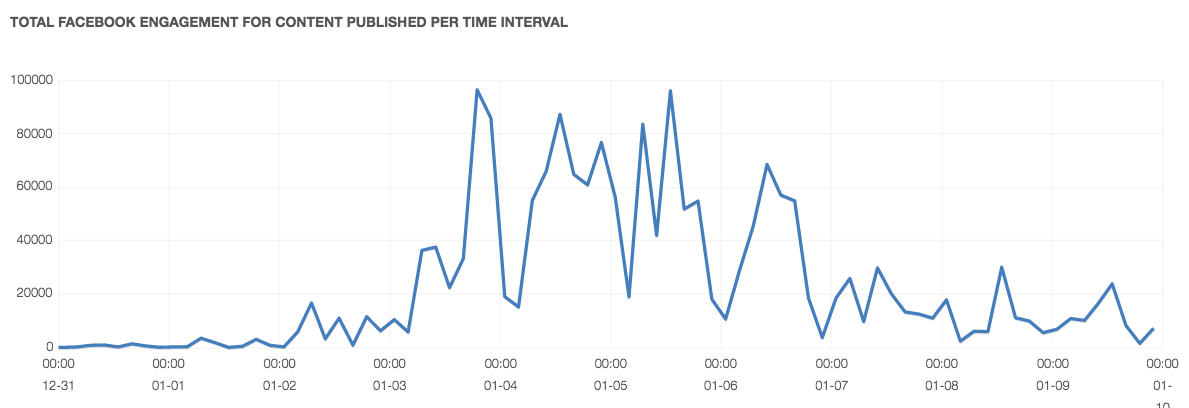
The exhibition ended Sunday, but we looked from December 31st through January 9th to see what drove some of the buzz across social media. This graph shows the engagements on Facebook.
Despite CES being over, there is still a good deal of activity on content as the new gadgets and tech continue to spur interest. Let’s dive into how publishers and social media covered CES.
The Top Publishers of CES
Which publishers had the most engaging stories around CES? We analyzed the Facebook engagements and Twitter shares to determine the publishers with the most engaging coverage. Technology-focused sites made big strides here, like The Verge, Mashable, CNET, Gizmodo, and TechCrunch.

USA Today, BBC, and CNN also drove significant engagement for their reporting. Youtube was not a surprising addition to the list, as videos can effectively demonstrate the new tech coming out of CES.
Our top publishers here make an appearance. The most engaging article came from USA Today, a roundup of the top products to come out of CES. For those who didn’t attend the show, a roundup or list can guide them to the most memorable gadgets. USA Today appeared again for another list article, “CES 2017: 7 devices I would actually buy.”
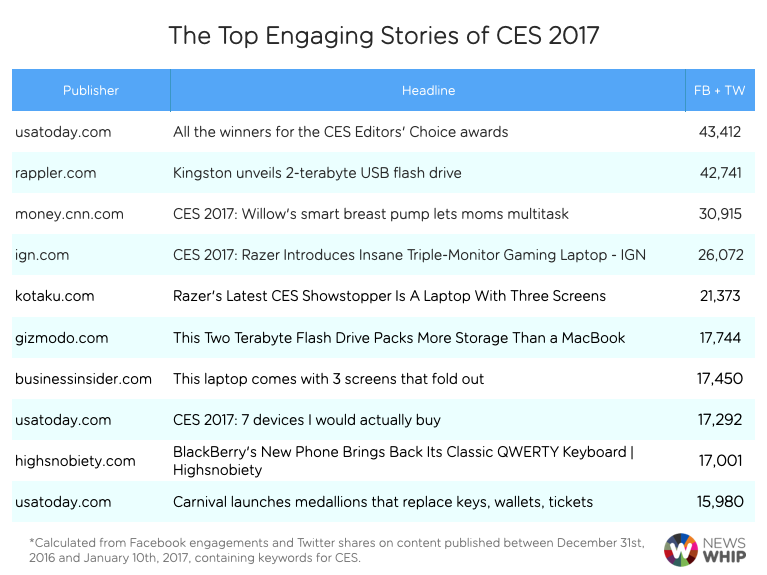
Many of the top articles were around the devices that came out of CES, including those from particularly well-known names like Blackberry and Razer. Most of the ten were tech-focused, and only two were concentrated on other areas.
Rappler is the only unknown in the top ten here, a self-identified “social news network where stories inspire community engagement and digitally fuelled actions for social change”. Rappler’s CES coverage nonetheless drove interest among their followers, with this story driving over 43,000 engagements on Facebook and Twitter.
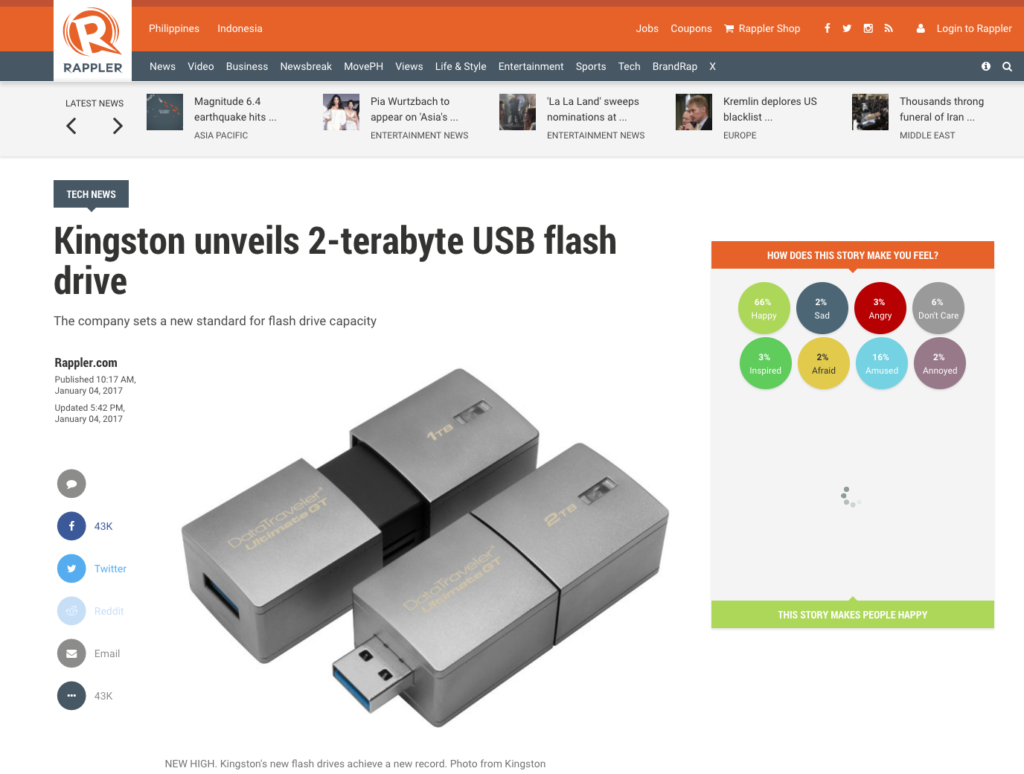
One interesting way Rappler encourages interactivity is through “emotion” buttons in the sidebar, similar to BuzzFeed’s reaction buttons at the end of content. Another way is through a robust Facebook following.
[fb_pe url=”https://www.facebook.com/rapplerdotcom/posts/1460908380596607″ bottom=”30″]
Just this Facebook post produced 24,000 reactions, 6,600 shares, and 1,500 comments from Rappler’s following of nearly 3.1 million readers. The article fell into our top ten for CES coverage.
If we look at LinkedIn, the top stories around CES tell a different story.
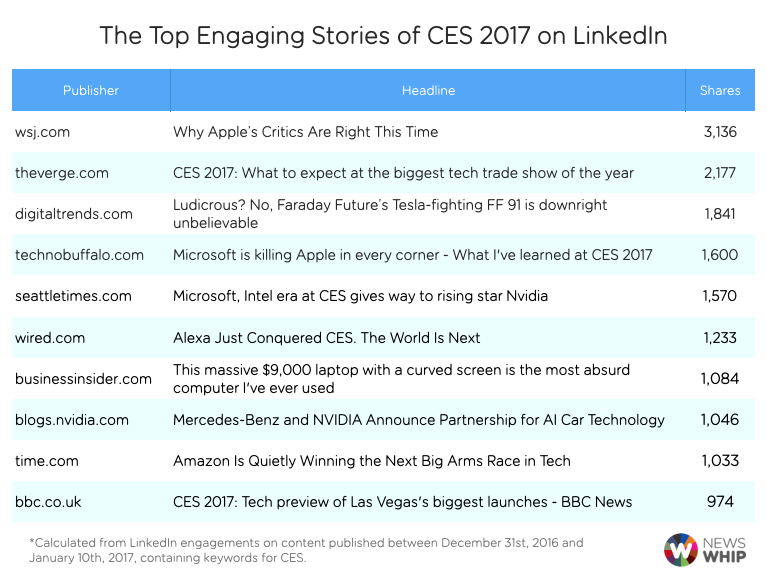
Most of these articles are focused on the companies themselves, instead of the innovations. The big names in tech here drove the highest amount of shares on LinkedIn. Apple, Tesla, Microsoft, Intel, and Amazon duke it out, making up six of the top ten articles. Artificial Intelligence in cars also made the top ten twice, as the horizon of self-driving cars grows ever closer.
The publishers here are different, as well. The Verge and BBC make appearances, but the other publishers, though mostly prominent, didn’t make our top ten of CES coverage on Twitter and Facebook.
How CES Played Out on Facebook
Speaking of Facebook, there can be a huge discrepancy in what’s driving engagements on a publisher’s domain, and what is the most engaging native Facebook content. When it came to which Facebook Pages saw the biggest interactions around CES, there was a steady mixture of publishers and brands.
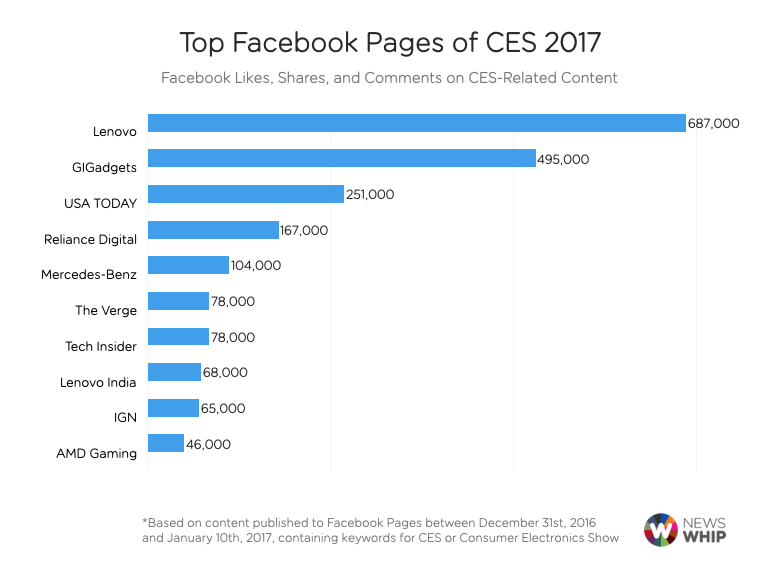
In terms of publishers, USA Today overtook the Verge as the top publisher of engaging native content, joined by the likes of Tech Insider and IGN.
But Lenovo was the big show-stealer on Facebook, with over 687,000 engagements on its CES content. Looking at the top engaging native posts, tech brand created four of the top ten posts around CES. This post, announcing new products, drove over 430,000 Facebook engagements alone.
If we look at the most-shared Facebook posts, GIGadgets eclipses the others, with seven of the top ten most shared posts.
[fb_pe url=”https://www.facebook.com/GIGadgets.Fans/videos/1265613170184636/” bottom=”30″]
The videos showed off the new tech coming out of CES through digestible, quick clips. The above video, less than a minute long, drove 4.3 million views and 53,000 shares. In the comments, GIGadgets linked to further articles and videos on the new gadget.
A digital native publisher, all of GIGadgets top posts were video content. Aside from Facebook’s own focus on video, it makes sense that the top native posts exploring new inventions, were also video. Out of the top 25 most engaging CES posts on Facebook, 16 were video, 6 were photos, and 3 were external links.
With Facebook, we can dig one layer deeper, into Facebook reactions. New tech tends to drive a lot of “Wow” reactions for the most awe-inspiring inventions. We can see which of the CES posts had the most “Wow” reactions.
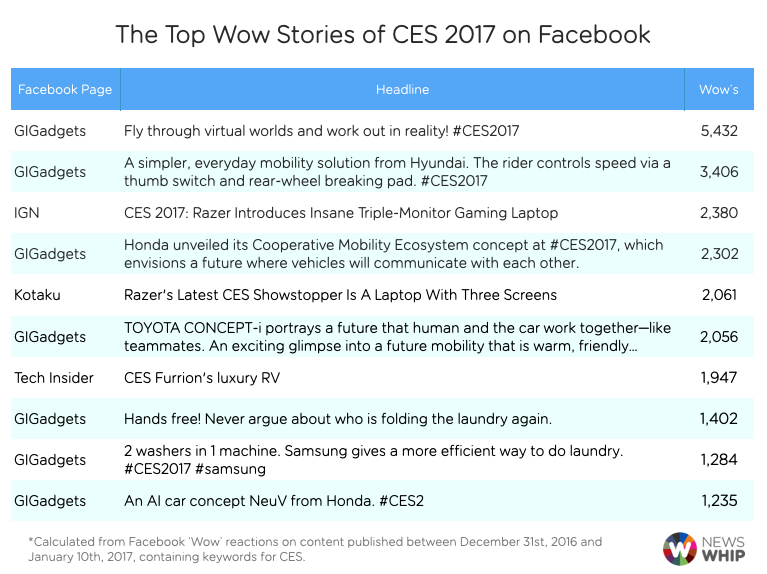
GIGadgets again created the posts that drove the most Wow reactions. Unlike what we saw for the top publishers’ domain content, on Facebook, the most Wow posts weren’t as often focused on computer tech.
Like on LinkedIn, there were quite a few posts around automobile and AI innovations. Two posts that drove significant Wows were about laundry, showing that we never stop trying to improve our mundane tasks.
Eight of the most Wow posts were videos and two were external link posts. Since videos require more attention and engagement time, it makes sense that they can drive the more in-depth reactions.
What’s Next
Seeing what drives the most attention on social media can be valuable for both brands and publishers alike. Which are the stories that drive the most engagement? Who told those stories the best? Which methods or formats resonated the most with readers?
Using data to power your storytelling can lead to big engagement wins. Ahead of a major event like CES, historical social media metrics can help determine which stories have staying potential.
Take a free trial of NewsWhip Spike to start adding social proof to your storytelling