
The AT&T Time Warner merger could be one of the biggest business news stories of the year. How did social media users react to the data on social media?
AT&T’s weekend acquisition of Time Warner, consisting of HBO, Turner Broadcasting and Warner Bros., is set to one of the biggest business news stories of the year.
Unsurprisingly, the story blew up quickly on social media, from the rumours on Friday afternoon, through the weekend when the deal was announced and presidential candidates made statements on the deal.
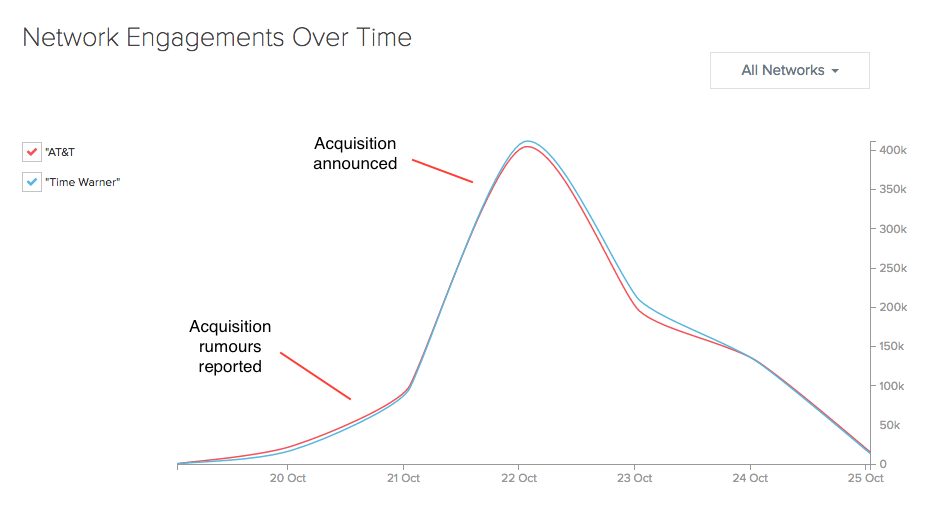
Here’s how engagement around stories mentioning ‘Time Warner’ or ‘AT&T’ in the heading and subheading evolved from October 20th (before news of the potential deal emerged), to today, October 25th. The graph counts all engagements on Facebook, Twitter, LinkedIn and even Pinterest, and comes from NewsWhip’s new Analytics tool.
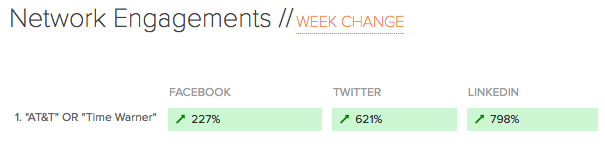
When the deal was confirmed there was significant interest on Twitter, with around 225,000 tweets of stories mentioning ‘AT&T’ in the topline from October 20th to 25th. Overall, engagements on stories mentioning both brands jumped hugely on Facebook, Twitter and LinkedIn. Data again via NewsWhip Analytics:
The engagement peaked on Saturday, when the deal was confirmed.
Where did audiences turn for their merger news?
Looking at the data around individual stories, we see that the news of the deal itself was the most engaging topic, and the publishers that were best placed to add detail and another additional info early in the story cycle benefitted most.
These were the ten sites with the most engagements for stories with “AT&T” or “Time Warner” in the headline and subheading from October 20th to 25th.
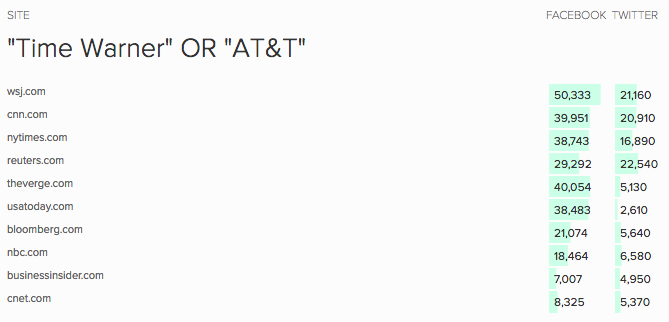
Despite huge interest on both platforms, ultimately it was Facebook where engagement kicked in on Saturday. The top five breaking news stories (Wall Street Journal, the Verge, the New York Times, CNN Money and USA Today) making up 45% of the total engagements on the platform.
We’ve already reviewed why it can be very advantageous to publishers to break news first on social, and this example illustrates that perfectly. Overall, the biggest story of the whole deal (so far) was the Wall Street Journal’s breaking news piece on the deal.
Why did it work?
In our analysis of the most engaged business sites on Facebook last week, we mentioned that the WSJ’s approach to sharing exclusives as free-to-read on social media was helping push their engagement metrics up and up. This was certainly a factor here.
Looking in Spike, we can easily track the key steps that sent that post on its way on Facebook and Twitter. Firstly, it was the earliest substantial news report on the deal that we could find. They published at 6.24pm GMT, ahead of the Verge (6.39pm), the New York Times (7.06pm) and USA Today (7.26pm). That meant that the WSJ was able to break this news first to its established social audience on different platforms ahead of everyone else.
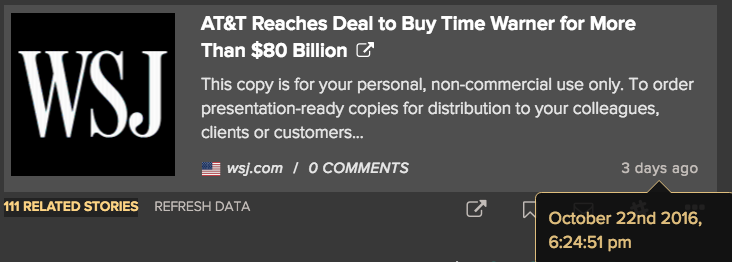
At the same time the story went live on their site, they posted that this tweet, which was retweeted over 1,800 times:
Breaking: AT&T reaches deal to buy Time Warner for more than $80 billion https://t.co/mGzzxZBZIq
— The Wall Street Journal (@WSJ) October 22, 2016
Just over an hour later, the post got another huge bump when Journal staffer Todd Olmstead tweeted the link out, adding some contextual information that added depth to the story for Twitter readers:
Handy guide to who owns what https://t.co/lwkM4hJ4Lv pic.twitter.com/Tnl2oetOoS
— Todd Olmstead (@toddjolmstead) October 22, 2016
Things took a little longer to spark off on Facebook, but engagements weren’t long accelerating. The initial post from the WSJ’s main Facebook page came around 20 minutes after their first tweet.
[fb_pe url=”https://www.facebook.com/8304333127/posts/10154824028348128″ bottom=”30″]
An hour later, the Breaking News Facebook page shared the story to their followers, creating more engagement on Facebook. But it was a share from Bernie Sanders’ official Facebook page a few hours later that really sparked an uplift in news feed visibility.
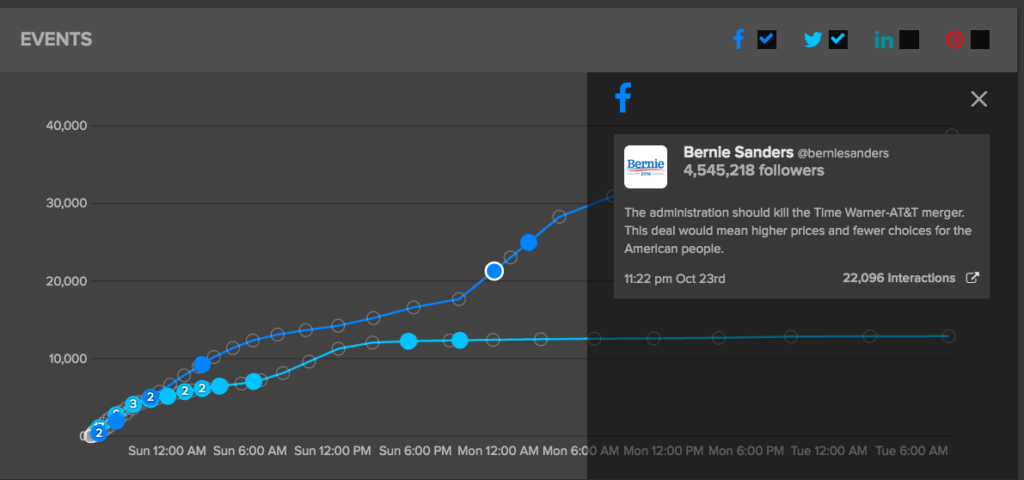
So, what can publishers learn from this? Engagement patterns on different social networks can differ, particularly on Facebook where a large audience might not see the story until a few hours after it was initially posted. But by establishing yourself as the authority around that story, you stand better-placed to capitalise on the potential engagement.