
Following on from our look at Facebook Reactions for publishers and sports teams, here’s how audiences are interacting with political content.
Of all stories, political content is among the most emotive. Stories about elections, issues, and legislative changes frequently provoke heated discussion and reactions among users. In this sense, Facebook Reactions and political content are natural bedfellows. Reactions offers users a broader range of options for showing how they feel about a story, allowing them to express deep, keenly-felt opinions with the click of a button.
To get a feel for how users are invoking Facebook Reactions on political content, we took a look at stories from five publishers across a 20-day period between May 1st to 20th. The publishers we looked at were Politico, The Hill, BuzzFeed Politics, CNN, and the Washington Post. Here’s what we found.
“Like” remains the most common Reaction
Firstly, Facebook “likes” still account for the vast majority of Reactions. As noted in our other blogs on Reactions, a high volume of users still tend to click “like” rather than waiting the added second or so to bring up a Reaction. The relative ease of “liking” a piece of content means it’s the quickest way of acknowledging a story, and indeed, likes accounted for an average of 39% of Reactions on publishers’ top stories during this period.
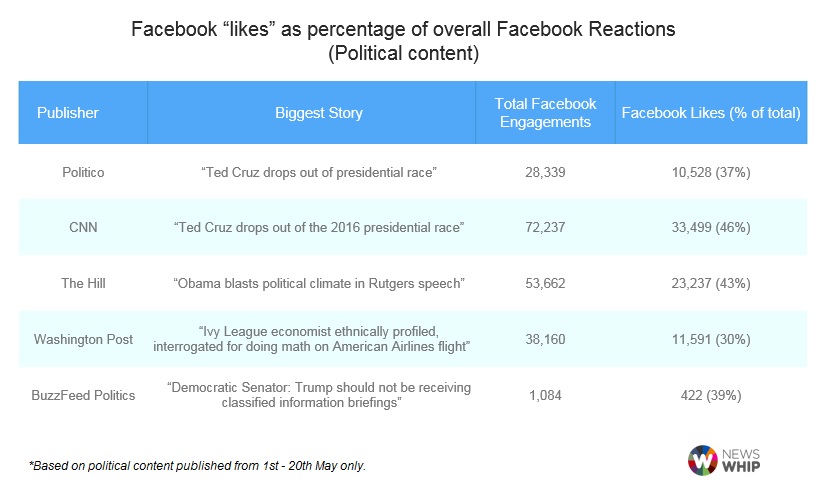 However, some publishers are seeing thousands of Reactions on individual posts. What’s more, they’re not always the ones you’d expect. Digital natives such as Politico and BuzzFeed Politics notched up fewer Reactions overall when compared to the likes of CNN and the Washington Post. The amount generated by each publisher relative to their total interactions was roughly commensurate for this period – broadly, it seems that users are embracing Reactions, just not in especially large numbers as yet.
Let’s explore the individual Reactions to see what content evoked different responses.
Ha-Ha
One figure dominated this Reaction, regardless of publisher: Ted Cruz. Stories about his dropping out of the US presidential race and unfortunate incidents involving his wife as well as his running mate brought out the schadenfreude in Facebook users. Cruz’s announcement that he would drop out of the race was the biggest story for this Reaction for Politico, with 1,227 “ha-ha”s. This equates to about 5% of the story’s total interactions. It also ranked highly for CNN, bringing in 4,336 such reactions or 6% of total interactions.
[fb_pe url=”https://www.facebook.com/cnn/photos/a.369810096508.159795.5550296508/10154760659066509/?type=3″ bottom=”30″]
Related stories about Cruz accidentally hitting his wife after his withdrawal speech and his running mate Carly Fiorina’s tumble off an event stage brought in a combined 2,487 “ha-ha” Reactions for The Hill, about 12% of total interactions for those stories.
Love
Similarly to “ha-ha”, one figure accounted for more usages of the “love” Reaction than anyone else this period – Barack Obama. The current US President characteristically evoked plenty of love from the masses, with stories featuring him hovering up affection on Facebook. The Hill’s audiences were particularly enamored with Obama. The publisher’s top story by “love” reactions was also its biggest piece of content overall for this period – a video of Obama giving a commencement speech at Rutgers University. This video earned 53,662 interactions in total, of which 2,279, or roughly 4%, were “love” Reactions.
[fb_pe url=”https://www.facebook.com/TheHill/videos/10153771612894087/” bottom=”30″]
BuzzFeed Politics also saw plenty of affection for the President. Stories about Obama’s support for transgender schoolchildren and his visit to Flint to meet a young schoolgirl who wrote him were especially popular. These earned a combined 178 “love” Reactions, about 21% of total interactions for those stories. When it comes to the goodwill of the masses, the current presidential hopefuls will certainly have a tough act to follow.
Sad
This Reaction popped up across an interesting range of stories. For the digital-first publishers, a large number of users invoked it in response to John Kasich’s withdrawal from the Republican presidential race. Kasich’s departure on May 4th came one day after Ted Cruz’s decision to drop out, leaving the polarizing Donald Trump to become the presumptive Republican nominee. This may be a factor in audiences’ responses. Politico, The Hill, and BuzzFeed Politics all generated a high volume of “sad” reactions from stories about Kasich’s decision to drop out. The Hill’s story on the announcement notched up 340 “sad” reactions from a total of 6,637 interactions. Politico’s piece earned 696 from 11,989 total interactions.
However, the story didn’t figure in either CNN or The Washington Post’s biggest stories under this Reaction. CNN’s rankings were dominated by coverage of the disappearance and crash of EgyptAir flight 804. Video coverage – including a live video – generated a combined 6,483 “sad” reactions as audiences expressed sympathy and sadness over the incident.
[fb_pe url=”https://www.facebook.com/cnn/videos/10154817390846509/” bottom=”30″]
Notably, this story emerged on May 20th, the last date we looked at while gathering data for this piece. The fact it elicited such a strong response from users – considerably more than older stories – is testament to the human element of the story. Audiences are quick to identify and sympathize with tragic stories, using the tools provided by social media to show support for and solidarity with those affected.
Wow
Compared to the other Reactions, “wow” has a less obvious place in the pantheon of political stories on social. Whereas “ha-ha”, “angry”, and “sad” are easy to predict depending on the story, it’s not immediately clear what kind of political content might elicit a jaw-drop from users. That said, one story figured prominently here – the same one which dominated usage of the “ha-ha” reaction. Ted Cruz’s decision to drop out was greeted with as much surprise as it was amusement, if social data is anything to go by. The story earned hundreds of “wow” reactions for the Washington Post, CNN, Politico, and BuzzFeed Politics, with CNN notching up the most at 1,858 uses of this reaction (about 3% of the story’s total interactions). The audience response can perhaps be understood in the context of Cruz having been the only other candidate with a chance – albeit slight – of toppling Trump’s quest for the nomination. His decision to withdraw before the relative outsider Kasich provoked a strong response from users.
Elsewhere, The Hill received its highest amount of “wow” reactions this period for a story about Bernie Sanders supporters in West Virginia claiming they would vote for Donald Trump before Hillary Clinton. This earned 404 “wow” reactions, roughly 6% of the story’s total engagements. The Washington Post’s coverage of an Ivy League professor who was questioned after doing maths calculations on a flight earned 1,527 “wow” reactions.
Angry
A cynical user might see this Reaction as the most obvious for engaging with political content. However, our research shows that “haha” was invoked most often, with “angry” Reactions relatively low across the board. Further, the data suggests that audiences used it to respond to a wide range of stories. Coverage of an Oklahoma bill which would see abortion made a felony in that state prompted several “angry” reactions from Politico and The Hill readers. The Hill’s story elicited 1,021 “angry” reactions in total; approximately 23% of its total engagements.
CNN and Washington Post audiences again differed in their use of the “angry” reaction. In particular, a story about George Zimmerman’s auctioning of the gun which killed Trayvon Martin generated an intense response from readers. The story elicited 2,299 “angry” reactions from Washington Post audiences – about 20% of its total engagements. CNN’s live video about the story elicited 1,421 “angry” reactions from readers, corresponding to 18% of the total engagements.
So, having analyzed the above, what are the main learnings on how Facebook audiences use Reactions around political content?
- Ha-ha is the most commonly used reaction for this period, provoking a broadly similar volume of responses for each publisher around specific stories. Interestingly, usage of the “angry” reaction was relatively low by comparison.
- Readers use Reactions to respond to a wide range of stories. For each instance of amusement at a candidate’s decision to depart the US election race, there are showings of support for tragedies in countries across the globe. Audiences are quick to put aside mainstream political stories to express sympathy and solidarity.
- Unsurprisingly for the year that it’s in, US Election 2016 stories are provoking huge volumes of Reactions. This analysis offers a snapshot of a tiny portion of the race, and with it set to continue for several months yet, we’re likely to see increasingly invested reactions from users.