
The Boston Globe’s Social Media Director tells us how his team is using Facebook live video, Instagram and more to connect with readers.
As one of the largest regional news outlets in America, the Boston Globe is firmly at the forefront of local digital journalism.
The Globe runs two main sites. BostonGlobe.com is a paywalled operation, charging 99c a day for access, while boston.com is a free-to-read site. The sites’ approach to growing their online audience has been praised by media analyst Ken Doctor, amongst others.
And with Spotlight having won Best Picture at the weekend’s Oscars, the Boston Globe is very much making headlines of its own at the moment.
We talked to Matt Karolian, Social Media Director at the Boston Globe and boston.com about how the two sites are reaching their readers on social media.
Hi Matt. What does your working day look like?
Everyday is a little different. Sometimes I am working with my team to help cover major breaking news events, other times I’m meeting with journalists and editors to plan social promotion around enterprising pieces, and some days I am head down in excel, working to ensure everything we do is measurable.
How important is social media in reaching your readers? What metrics do your team find most useful?
Social is everything to us. People are active on social media to broadcast their identity and participate in conversations with their friends, our content helps them do both.
We are active on all of the major platforms, Facebook, Twitter, Instagram, etc. We’ve been witness to Facebook’s incredible ability to drive traffic, while also seeing how we can very, very, quickly grow a large, highly engaged audience on Instagram.
In terms of metrics, I’ll probably sound like a broken record, but reach and engagement are what it is all about.
The Globe is cited as a successful model for regional journalism. What’s the key to making a meaningful connection with local readers on social media?
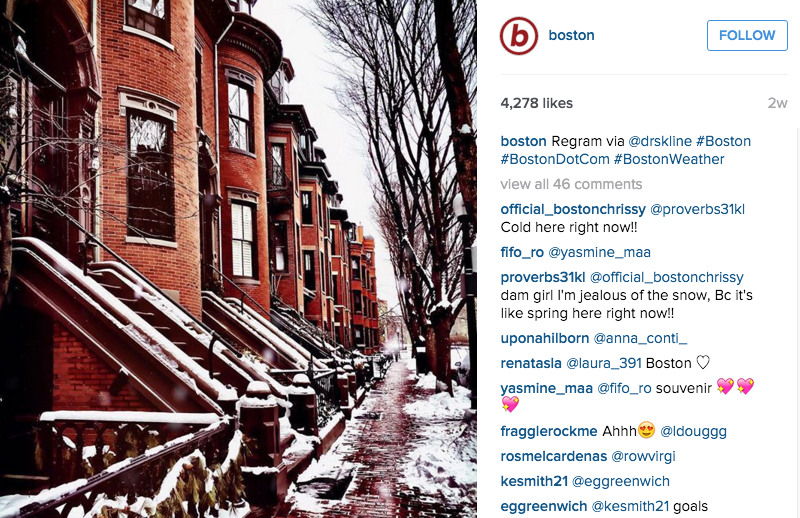
As I mentioned before, people exist on social media to help broadcast their identity and converse with friends. A huge part of one’s identity is where they live. We are able to effectively provide content that satisfies that part of their online experience.
For example, simple scene setters that highlighted the blizzards from last winter performed phenomenally.
Can you tell us a little about how your team is using video on Facebook and elsewhere?
Like many publishers, we have seen massive opportunity in delivering content natively through Facebook. In 2015 Boston.com generated well over 12 million views, which is orders of magnitude more than what we were able to deliver through our site.
We are just starting to dip our toes into the water when it comes to 360 video. We were able to shoot a 360 video from inside the first campaign rally Hillary Clinton held after leaving Iowa. It was a great way of putting our audience in the center of what it is like to be at such an event. That video alone generated roughly 215,000 views.
How is your team using Spike?
Spike has let us see stories that are in the “pre-trending” phase, allow us to get a jump on writing about them before they are all over the internet.
Finally, what advice can you share with publishers looking to grow their social communities?
Think about where your reader will find your story. Think about where readers will share your story. Think about what apps are on the home screen of your readers’ phones. Be relentless in your understanding of how readers will collide with your content.
Join leading newsrooms and try Spike for free today